An Approach to the Characteristics of Numbers
by Frank C. Fung ( 816 pages ) - 1st published in November / 2003
( this paper is dedicated to Charles H.L. Fung 1909-2002 )
This paper looks at the multiplication of numbers .
KEY FINDINGS :
Finding #1 : The hyperbola :
Every multiplication { Z = X * Y } has associated with it a { Difference-Of-Squares } equation : { Z = V^2 - U^2 } , with [ V ] & [ U ] being the { Half-Sum } & { Half-Difference } respectively.
In paticular a { positive 'odd' integer } of the format '4*K + 1' can be expressed in the format :
{ positive 'odd' integer } = { 'odd' number }^2 - { 'even' number }^2
And a { positive 'odd' integer } of the format '4*K + 3' can be expressed in the format :
{ positive 'odd' integer } = { 'even' number }^2 - { 'odd' number }^2
Finding #2 : Fermat 'Sum-of-Two-Squares' equation :
Every 'C-TYPE' equation :
{ C = D^2 + E^2 = F^2 + G^2 }
with { 'D' , 'F' being 'even' } & { 'E' , 'G' being 'odd' }
has associated with it a corresponding 'Q-Type' equation :
{ Q = D^2 - F^2 = G^2 - E^2 }
Setting { Q = [ 2^(POT-Q) ] * [ IQ-ODD ] } , where :
[ 2^(POT-Q) ] is an { integer-'Power-of-'2'' } and (POT-Q) is the Power-Of-Two for 'Q'
[ IQ-ODD ] is a { positive 'odd' integer }
permitted us to :
expand the equation { Q = G^2 - E^2 } involving [ 'odd' squares ] via :
the [ integer grid-points ] on the hyperbola { IQ-ODD = IETA-ODD * IZETA-ODD }
expand the equation { Q = D^2 - F^2 } involving [ 'even' squares ] via :
the [ integer grid-points ] on the hyperbola { IQ-ODD = IETA-ODD * IZETA-ODD } , using a procedure similar to the one usd for [ 'odd' squares ] above, but with a new 'twist'.
the [ 'Difference-Of-Squares' ] ' expansion procedure in 'Findings #1' above, whenever [ POT-Q ] is 'even', in addition to the procedure immediately above.
The 'C-Type' equation { integer grid-points } in the 4-Diensinal Space for { D , E , F , G }
Finding #3 : Fermat Numbers
We used the 'Augmented Binary Format' which is based on the concept of 'adding' a single [ 1 ] to a [ bundle of '1's' ] , e.g. :
1 1 1 1 1 1 1 + 1 = 1 0 0 0 0 0 0 0
so that a { bundle of '1's' } in a binary number may always be replaced by :
adding a [ higher-ordered Power-Of-'2' ] ( symbolized by a 'red-color ball' ), and
subtracting a [ lower-ordered Power-Of-'2' ] ( symbolized by a 'blue-color ball' )
We then combined adjacent { 'red-color'/'blue-color' balls' } to complete the conversion to the 'Augmented Binary Format'.
We then have the factorization of the 5th , 6th & 7th Fermat Numbers :
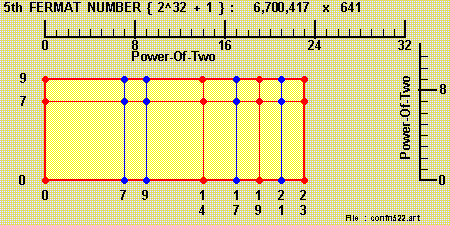
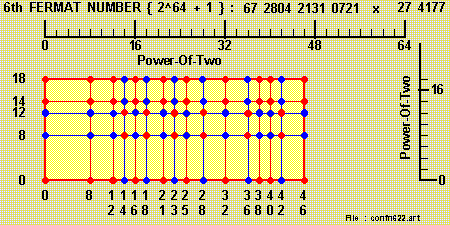
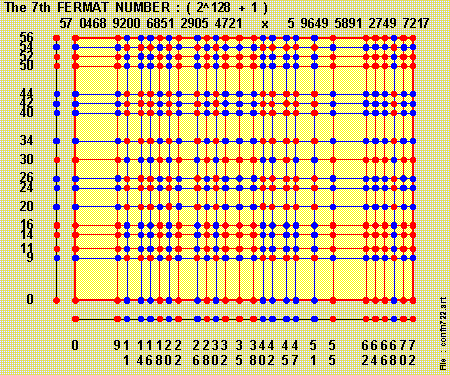
'Ricochet-in-the-BOX' & 'Shape-Of-BOX'
Finding #4 - The Fermat Little Theorem
{ FIRON-a/P } arises from the Fermat Little Theorem and is defiend by the value 'X' such that :
{ a^X } = { 1 modulo P }
where : 'P' is 'prime' & { 0 < a <= [ P - 1 ] }
such that:
{ a^Y } is not equal to { 1 modulo P } for { 1 < Y < X }
We then constructed the 'Multiplication Table' for { modulo 13 } via the 'Swing-from-the-diagonal' procedure :
We first place 12 [ 1's ] , 12 [ 2's ] , ...... , 12 [ 12's ] on the diagonals of 12 [ 12 x 12 ] 'Square Boxes'
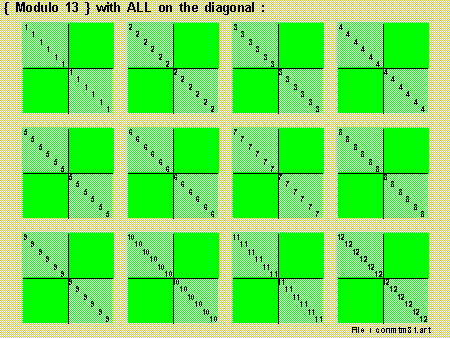
We then 'swung-out' the numbers from the 'diagonals' to the appropriate places:
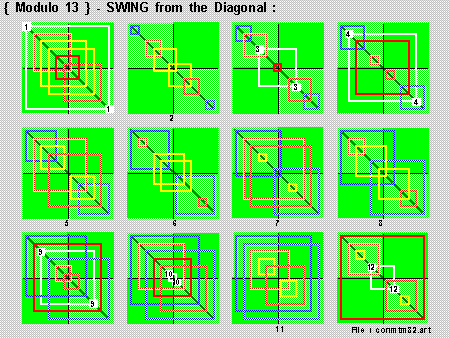
And the numbers remaining on the 'diagonals' are marked by the 'white-color' square.
We then combine/super-impose the 12 [ 12 x 12 ] 'Square-Box' to get our 'Multiplication Table' { modulo 13 }.
Multiplication Tables { modulo P } can be looked at from a 'combinatorial' stand-point.
If we used 'symbols' instead of 'numbers' on our 'Multiplication Table' for { Modulo P } and we got the 'symbols' mixed up, we would still be able to egt on with the construction, it is only a matter of selecting the 'correct' combination of 'Swing-outs-from-the diagonal' to use.
'Squares' on the diagonal are important and we squared the numbers remaining on the diagonal to get a reduced set of numbers
We keep on this 'Squaring'p rocdeureto get 'redueced sets' until the size of reduced sets' no long shrinks.
And this laid the foundation of our 'Squar-Of-Square' diagrams :
Finding #5 - Squares-Of-Squares
'Keep-on-squaring' staring with the number '2' means :
2 x 2 = 4 ( squaring '2' once)
4 x 4 = 16 ( squaring '2' twice )
16 x 16 = 256 ( squaring '2' - 3 times )
256 x 256 = 65536 ( squaring '2' - 4 times )
And so-on-and-so-forth.
for the 'prime' number { 233 = 8 * 29 + 1 } the equation :
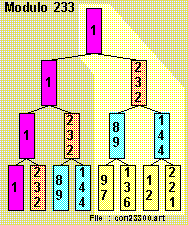
{ X^8 } = { Y modulo 233 }
has solutions for { Y = 1 }
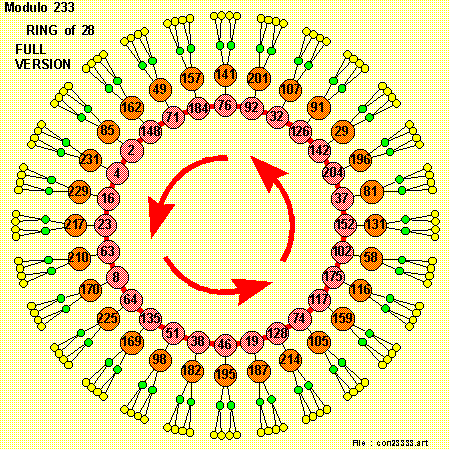
and for
{ Y = 2 , 4 , 16 , 23 , 63 , 8 , 64 ,
135 , 51 , 38 , 46 , 19 , 128 , 74 ,
117 , 175 , 102 , 152 , 37 , 204 , 142 ,
126 , 32 , 92 , 76 , 184 , 71, 148 }
This latter group is then known as the 'RING-OF-28' :
Finding #6: The Logarithmic Process
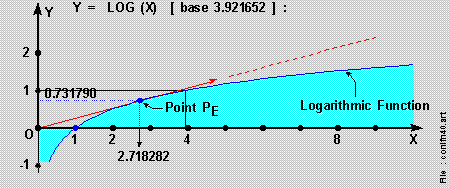
{ e = 2.718281...... } is defined via a { tangent-line } to the curve { Y = Log (X) [ base 'A' ] } passing thru the { Point-Of-Origin }, where { 1 < A < infinity }.
And the curve may be constructed alternate via { X = A^Y }.