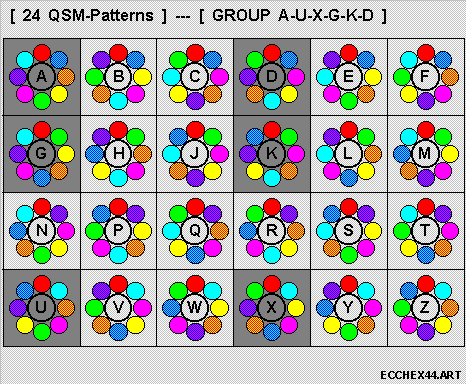
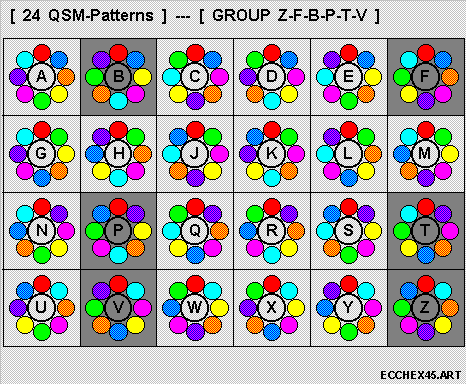
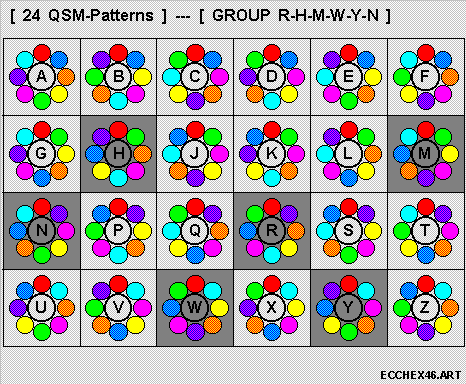
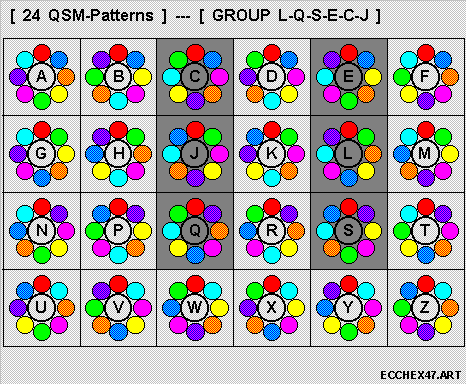
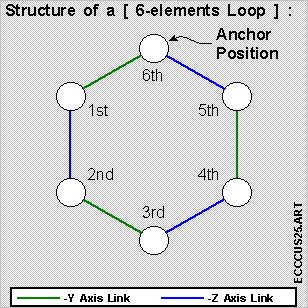
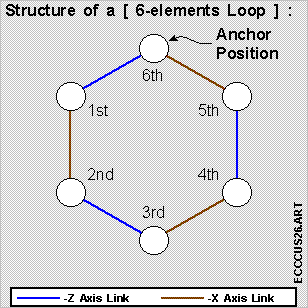
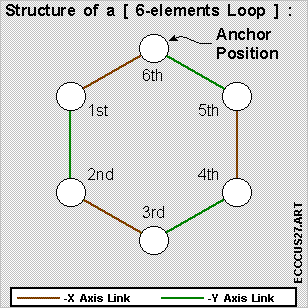
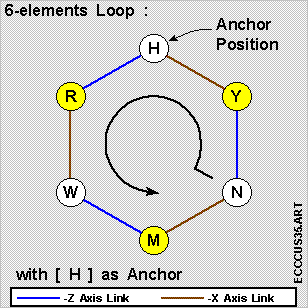
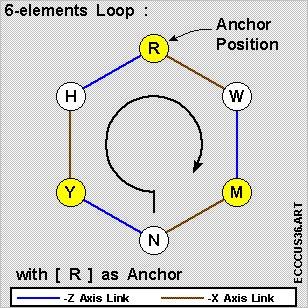
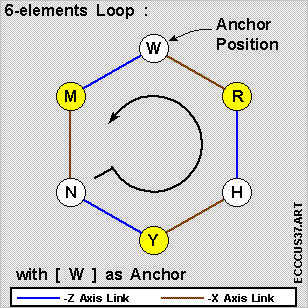
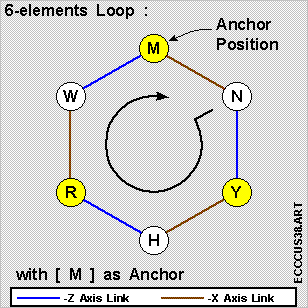
And these 4 [ Quasi Hexa-Symmetric Sets ] with 6 elements each are :
And these are :
although the listing-order-for-the-6-elements within each pair of matching-sets are quite different .
( But the [ listing-order ] here is only a minor issue because :
will remain in tact regardless of the listing-order-for-the-6-elements .)
As such ,
And for this purpose , let us now bring-in again this set of 3 Linkage Diagrams from the previous section , Section XXV :

And we take special note here that :
involves only [ 2-notch rotations ] in the [ -Y Axial-Direction ] and the [ -Z Axial-Direction ] ;
involves only [ 2-notch rotations ] in the [ -Z Axial-Direction ] and the [ -X Axial-Direction ] ;
involves only [ 2-notch rotations ] in the [ -X Axial-Direction ] and the [ -Y Axial-Direction ] ;

And we shall now make two (2) key observations here , for our usage to follow .
For each of 3 types of the [ 6-elements loops ] above :
As such :
and
and

And we can see here then that :
and
( The [ 6th Position ] above then defines a self-on-self [ Structural Mapping relation ] with respect to the [ Anchor Position ] . )
And the applicable [ structural view ] diagrams here are then :

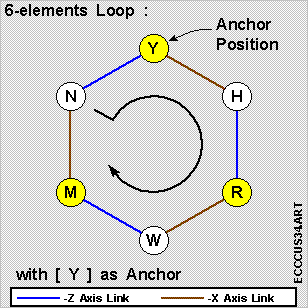
Let us now plug-in [ N ] / [ Y ] / [ H ] / [ R ] / [ W ] / [ M ] into the [ Anchor Position ] ,
to arrive at this set of 6 diagrams , below .


And we can see here that :
is then an iron-clad confirmation that [ N ]-[ Y ]-[ H ]-[ R ]-[ W ]-[ M ] do form a [ Quasi Hexa-Symmetric Set ] .
And we can now follow a similar procedure to identify the other [ Quasi Hexa-Symmetric Sets ] .
and
then raise an interesting question on the parity-issue for the [ 6-elements loop ] .
But this is an issue that can be readily counter-balanced / resolved by the fact that :

i.e. :
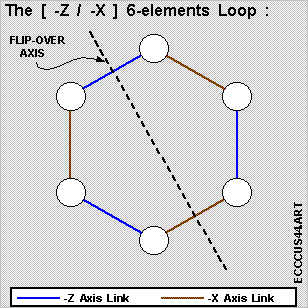
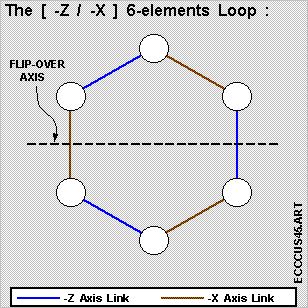
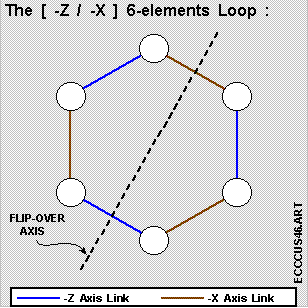
the flipped-over [ 6-elements loop ] would look exactly-the-same as the [ 6-elements loop ] before the Flip-Over !
A quick example here is in order :

we would then arrive at the [ 6-elements loop ] in the diagram on-the-right , above .
And this then allowed us to switch the [ Configuration-in-the-Anchor-Position ] from [ N ] to [ Y ] in a jiffy .