An Approach to the Four Body Problem
by Frank C. Fung - 1st published in December, 2007.
Section II - The 12 Degrees-Of-Freedom for the Tetrahedron
The 12 Degrees-Of-Freedom :
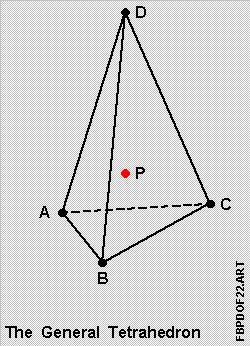
- Let us now set up a general { Tetrahedron } as shown below :
- and identify [ Point P ] as the { Centroid } of the { Tetrahedron } .
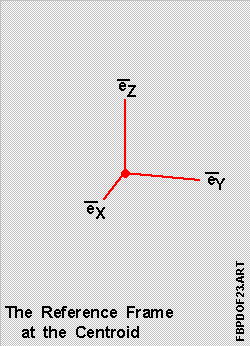
- We then set up a { Reference Frame } at [ Point P ] , as per the diagram in-the-middle , above .
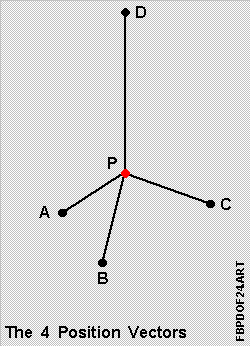
- The { Tetrahedron } can therfore be defined via the 4 { Position Vectors } , as shown in the diagram on-the-right , above .
Defining the { Tetrahedron } , therefore , involves 12 Degrees-Of-Freedom ( DOF's ) at the outset , i.e. { 3 DOF's } for each of the 4 { Position Vectors } .
- But because we are referencing via the { Centroid } , i.e. [ Point P ] , these { 12 DOF's } are immediately reduced to { 9 DOF's } ,
Rotating the Tetrahedron :
- In general , rotating a { Reference Frame } of { 3 orthogonal unit-vectors } involves only { 3 Degrees-Of-Freedoms } :
- Positioning the { 1st unit-vector } involves { 2 DOF's } :
- while the new { x-y-z co-ordinates } here involves { 3 DOF's } , the restriction that this is a { unit-vector } reduces this down to { 2 DOF's } .
- Positioning the { 2nd unit-vetcor } involves only { 1 DOF } :
- This is because the { 2nd unit-vector } must resides in the { plane } orthogonal to the { 1st unit-vector } , so that the positioning here can involve only { 1 DOF } .
- Positioning the { 3rd unit-vector } involves { zero DOF } :
- This is because this { 3rd unit-vector } is always the { cross-product } of the first { 2 unit-vectors } and is necessarily orthogonal to both .
- Thus , the rotation of the { Tetrahedron } as a whole , or alternately re-orienting the entire { Tetrahedron } , always involves a further { 3 DOF's } ,
- so that only { 6 DOF's } can be involved in defining the { size and shape } of the { Tetrahedron } .
We shall look at these 6 { Degrees-Of-Freedom } , i.e. the { 6 DOF's } , next .
original dated 2007-12-16