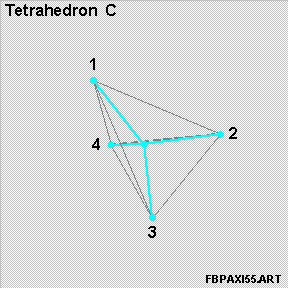

We now also present the { co-ordinates } for the 4 { Centroid-based Position Vectors } for { Tetrahedron A } and { Tetrahedron C } , for authentication purposes .
| Nodal Point |
Tetrahedron A | Tetrahedron C | Cross Product | ||||||
|---|---|---|---|---|---|---|---|---|---|
| X | Y | Z | X | Y | Z | X | Y | Z | |
| Mass #1 | +0.000 | -180.000 | -135.000 | -165.789 | -318.300 | +264.400 | -90,562.500 | +22,381.579 | -29,842.105 |
| Mass #2 | +240.000 | +0.000 | -180.000 | -165.789 | +366.100 | +31.867 | +65,898.000 | +22,194.105 | +87,864.000 |
| Mass #3 | -240.000 | +180.000 | -160.000 | +194.211 | +96.100 | -328.133 | -43,688.000 | -109,825.684 | -58,021.895 |
| Mass #4 | +0.000 | +0.000 | +475.000 | +137.368 | -143.900 | +31.867 | +68,352.500 | +65,250.000 | +0.000 |
| Total | +0.000 | +0.000 | +0.000 | +0.000 | +0.000 | +0.000 | +0.000 | +0.000 | +0.000 |