

where :
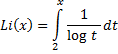
Both of these involve { logarithms } .
We note , at this point , that Riemann also brought-in the { power-of-primes } into the picture , via his { f(x) function } :
- and this might be an improvement , to the extent that :
- { square-of-primes } are on the { 1, 1 } diagonal in the [ 2-D plane ] , and are singular in nature ;
- { cube-of-primes } are on the { 1, 1 , 1 } diagonal in the [ 3-D space ] , and are singular in nature ;
- { 4th-power-of-primes } are on the { 1, 1, 1, 1 } diagonal in the [ 4-D hyper-space ] , and are singular in nature .
May be Riemann already had a better vision on the process of knocking-off { non-prime numbers } ?
- Simply don't know and can't tell .