


| Topic I | Introduction & Summary for the Section |
| Topic II | Recalling the { linear mapping } relation |
| Topic III | Linear Mapping Basics |
| Topic IV | Setting up the { Unit-Sphere } in { Reference Frame B } |
| Topic V | Setting up the quantity { Rho-T } |
| Topic VI | Identifying the Maximum |
| Topic VII | An Analysis of the Maximum |
| Topic VIII | The 'mapped' Ellipsoid |
In this section, we shall take a further look at the { linear mapping } relation we have previously developed in { Section 1 } .
Our key finding here is that :
Let us now recall the { linear mapping } relation we have previously developed in { Section 1 } :
Let us now set up two (2) { 3-Dimensional reference frames } :
 ,
,  ,
,  } ,
} ,
as per these two (2) diagrams below :
 &
& 
 &
& 
Let us now focus on the following three (3) relations of particular interests :


This then maps the { unit-vector } [  ] in { Reference Frame B } onto the [
  ] vector in { Reference Frame A } , with :



This then maps the { unit-vector } [  ] in { Reference Frame B } onto the [
  ] vector in { Reference Frame A } , with :


This then maps the { unit-vector } [  ] in { Reference Frame B } onto the [
  ] vector in { Reference Frame A } , with :

as per this pair of diagrams below :
 &
& 
Let us now set up a { unit-sphere } in { Reference Frame B } so that :
 } is a point on this { unit-sphere } surface , as per these two (2) diagrams below :
 &
& 
The { unit-vector }  is then given by :

 ,
,  ,
,  } satisfying the governing equation for the { unit-sphere } , i.e. :

The { unit-vector } { } in { Reference Frame B } is then mapped onto the vector {  } in { Reference Frame A } , as per this pair of diagrams below :
 &
&
We shall now identify / re-label the vector { } as the vector {  } , and we can write :

And the mapping relation here is then :


yielding the relations :


Let us now introduce the scalar quantity {  } , such that :

] is then the size of the vector [ ] .
We can then write :

yielding, on expansion :

Then, for all points on the { unit-sphere } in { Reference Frame B } , satisfying the condition :
there is a particular set of values for { , , } such that the value of  is at a maximum.
Let us suppose that we were able to identify such a set of values for { , , } such that the value of is at a maximum.
We shall then label this set of values as the set {  ,
,  ,
,  } .
} .
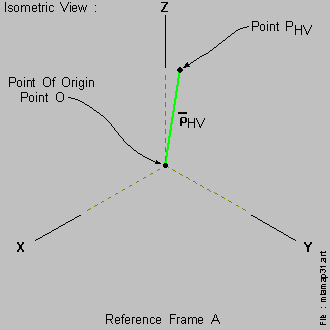
We then identify, in the diagrams below, points and vectors associated with this set , the set { , , } , which in turn is associated with the highest value of :
 &
& 
 in { Reference Frame B } , as identified by the points {
  } & {
} & {  } respectively , is then given by :

in { Reference Frame B } then maps onto the vector  in { Reference Frame A } , as identified by the points { } & {
  } respectively . And is given by :

where :


The scalar quantity / value  , i.e. :

is then the value of associated with the set { , , } and it is the highest value for .
Let us now identify a { unit-circle } on the plane orthogonal to the { unit-vector } , in { Reference Frame B } , as per the right-hand-side diagram below :
 &
& 
This { unit-circle } in { Reference Frame B } then maps onto an { ellipse } in { Reference Frame A } , as per the left-hand-side diagram above.
Let the point, {  } , be a point on the { unit-circle } in { Reference Frame B } , as per right-hand-side diagram below :
 &
& 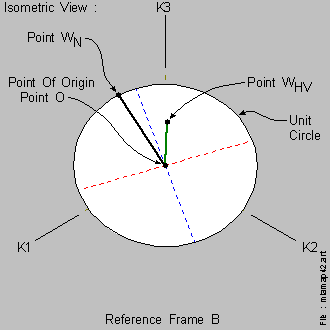
so that the vector  in { Reference Frame B } maps onto the vector
  in { Reference Frame A } , as per the left-hand-side diagram above.
We then summarize the current situation as follows :
in { Reference Frame B } maps onto in { Reference Frame A } ,
in { Reference Frame B } maps onto in { Reference Frame A } ,
and the { unit-vectors } & in { Reference Frame B } are orthogonal to one-another.
This then is a situation of a { 2-Dimensional Planar Mapping } of :
as per this pair of diagrams below :
 &
& 
( both the { 'new' unit-circle } & the { 'new' ellipse } are then marked in 'yellow-color' ) .
( The reader may wish to branch to Appendix B for a briefing on { 2-Dimensional Planar Mapping } at this point . )
We then identify the angle  as the angle
 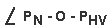 , as per the above left-hand-side diagram above.
Let us now investigate the three (3) possibilities for the value of , as follows :
is less than { 90 degrees } :

In this case, the { unit-circle } maps onto an { ellipse } but { } is not the maximum point .
is exactly { 90 degrees } :

In this case, the { unit-circle } maps onto an { ellipse } and { } is indeed the maximum point .
is more than { 90 degrees } :
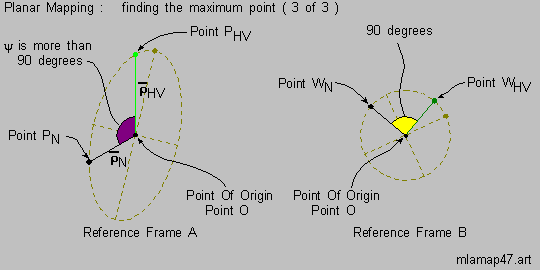
In this case, the { unit-circle } maps onto an { ellipse } but { } is not the maximum point .
Thus, the { 2nd Possibility } is the only viable case if { } is indeed the maximum point where attains its highest value.
That is to say :
is always 90 degrees.
The original { unit-circle } ,
, in { Reference Frame B } ,
then maps onto an { ellipse } ,
, in { Reference Frame A } ;
as per this pair of diagrams below :
 &
& 
We can then identify, via the procedure outlined in Appendix B on { 2-Dimensional Planar Mapping } :
 &
&  , respectively ,
in { Reference Frame A } ,
and also :
 &
&  in { Reference Frame B } that maps into these { major-axis } & { minor-axis } vectors in { Reference Frame A } , respectively,
as marked in the pair of diagrams immediately above.
We then have three (3) orthogonal { unit-vectors } in { Reference Frame B } mapping onto three (3) orthogonal vectors in { Reference Frame A } , i.e. :
, , &
mapping onto :
, , & , respectively.
We can then construct the corresponding { unit-sphere } mapping onto the { ellipsoid } accordingly :
 &
& 
We then also present this pair of diagrams :
 &
& 
identifying the { axis of the ellipsoid } and the { corresponding axis of the unit-sphere } .
We note here that the orientation of the { 3-axis } for the { ellipsoid } and for the { corresponding unit-sphere } maynot , and may, be different.
In the next section, we shall briefly go thru the mechanics for the rotation of a set of { orthogonal unit-vector Basis } in a { 3-Dimensional Vector-Space } , before further investigating the { rotational effects } of the { ellipsoid } in { Section 4 } .