


| Topic I | Introduction & Summary for this Appendix. |
| Topic II | The Set of { 3 Linear Equations } |
| Topic III | The Runge Katta Method in action |
| Topic IV | An Analysis of the { Determinant } |
The Runge Katta Method is a numerical method / procedure that provides a solution to a given set of { Linear Equations }.
This Appendix then runs thru the Runge Katta Method for a { 3 x 3 } matrix .
The [ Determinant ] for the general { 3 x 3 } [ Solution Matrix ] is also analysed with interesting results.
Let us now start out with this set of { 3 Linear Equations } and try to solve for the values of 'X' , 'Y' , & 'Z' .
 ' , '
' , ' ' , & '
 ' are given.
We shall now proceed to use the { Runge Katta Method } to arrive at the solution.
We then divide the { 1st row } by [ A ] to arrive at the 'equivalent' { matrix equation } :


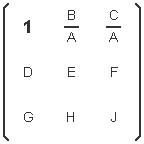

We then :
to arrive at :


yielding :


We then divide the { 2nd row } by { [ A*E - B*D ] / A } to arrive at the 'equivalent' { matrix equation }:

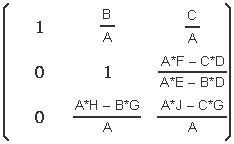
We then :
to arrive at :


yielding :

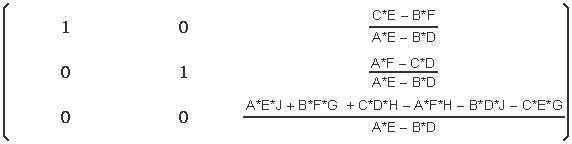
We then divide the { 3rd row } by :
to arrive at the 'equivalent' { matrix equation } :
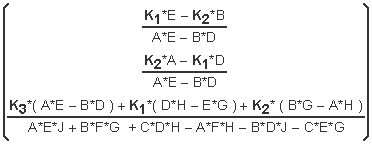

We then :
to arrive at :


Expanding and consolidating terms then yields :


where :

We can then write :
or simply :
Thus, for any given set of values for '' , '' , & '' , we can always find a set of values for 'X' , 'Y', & 'Z' via the [ equation for the solution ] presented here immediately above.
And we shall call this :
the [ Solution Matrix ] .
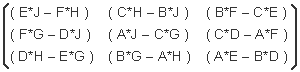
Let us now define the { Matrix [ W ] } as follows :

We can then write the above { equation for the solution } , in this format below :

Let us now look at the { Determinant } for the { Matrix [ W ] } .
And we introduce this table below, for { Matrix [ W ] } , for better clarity :
| COLUMN-1 | COLUMN-2 | COLUMN-3 | |
|---|---|---|---|
| ROW-1 | E*J - F*H | C*H - B*J | B*F - C*E |
| ROW-2 | F*G - D*J | A*J - C*G | C*D - A*F |
| ROW-3 | D*H - E*G | B*G - A*H | A*E - B*D |
The [ Determinant ] for this { 3 x 3 } matrix has six (6) terms :
| 1st term : | ( +1 ) | * | ( E*J - F*H ) | * | ( A*J - C*G ) | * | ( A*E - B*D ) |
|---|---|---|---|---|---|---|---|
| 2nd term : | ( +1 ) | * | ( C*H - B*J ) | * | ( C*D - A*F ) | * | ( D*H - E*G ) |
| 3rd term : | ( +1 ) | * | ( B*F - C*E ) | * | ( F*G - D*J ) | * | ( B*G - A*H ) |
| 4th term : | ( -1 ) | * | ( E*J - F*H ) | * | ( C*D - A*F ) | * | ( B*G - A*H ) | 5th term : | ( -1 ) | * | ( C*H - B*J ) | * | ( F*G - D*J ) | * | ( A*E - B*D ) |
| 6th term : | ( -1 ) | * | ( B*F - C*E ) | * | ( A*J - C*G ) | * | ( D*H - E*G ) |
We then have this calculation table below for the expansion :
| { square } terms |
{ non-square } terms |
||||||||||||||||||||
|---|---|---|---|---|---|---|---|---|---|---|---|---|---|---|---|---|---|---|---|---|---|
| A A E E J J |
A A F F H H |
B B D D J J |
B B F F G G |
C C D D H H |
C C E E G G |
A A E F H J |
A B D E J J |
A B D F H J |
A B E F G J |
A B F F G H |
A C D E H J |
A C D F H H |
A C E E G J |
A C E F G H |
B B D F G J |
B C D D H J |
B C D E G J |
B C D F G H |
B C E F G G |
C C D E G H |
|
| 1st term | +1 | -1 | -1 | +1 | -1 | +1 | +1 | -1 | |||||||||||||
| 2nd term | +1 | +1 | -1 | -1 | +1 | -1 | +1 | -1 | |||||||||||||
| 3rd term | +1 | +1 | -1 | -1 | +1 | -1 | +1 | -1 | |||||||||||||
| 4th term | +1 | -1 | +1 | -1 | +1 | -1 | -1 | +1 | |||||||||||||
| 5th term | +1 | -1 | +1 | +1 | -1 | -1 | -1 | +1 | |||||||||||||
| 6th term | +1 | -1 | +1 | +1 | -1 | +1 | -1 | -1 | |||||||||||||
| --- | --- | --- | --- | --- | --- | --- | --- | --- | --- | --- | --- | --- | --- | --- | --- | --- | --- | --- | --- | --- | |
| SUM of terms | +1 | +1 | +1 | +1 | +1 | +1 | -2 | -2 | +2 | +2 | -2 | +2 | -2 | -2 | +2 | -2 | -2 | +2 | +2 | -2 | -2 |
We simply note here that :

or ,

Let us now look at the [ Determinant ] for the { 3 x 3 } [ Solution Matrix ] .
We then have this relation below :

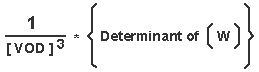
This is because :
so that the net effect is that :
in order to arrive at the proper value for the [ Determinant ] of the { 3 x 3 } [ Solution Matrix ] .
We then have :
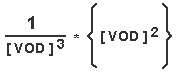

( This then also set the stage for "normalizing the Determinant", for a { 4 x 4 Matrix } and so-on-and-so-forth , should it become desirable to do so .)