 ,
,  , &
, &  respectively ,
| Topic I | Introduction & Summary for this Section |
| Topic II | Defining an { Eigen-Blackhole } |
| Topic III | Setting up the stationary { Reference Frames } |
| Topic IV | The Initial Set-up |
| Topic V | Creating the { Eigen-Blackhole } |
| Topic VI | The Final { Linear Mapping } relation |
| Topic VII | Visualizing the { Eigen-Blackhole } |
In this Section, we demonstrate that an { eigen-blackhole } does exist in certain 3-D { linear mapping } relations.
An { eigen-blackhole } arises whenever two (2) or more { eigen-vectors } :
in certian special /specific { linear mapping } relations.
Any combination of these said orthogonal { eigen-vectors } is then also an { eigen-vector } ,
Let us first set up, again, the 3-Dimensional { Global Reference Frame } , as identified by the set of { orthogonal unit-vector Basis } , , & respectively ,
 &
& 
which shall remain fixed and constant throughout our analysis in this Section.
Let us also set up two (2) more { Reference Frames } :
 ,
,  , &
, &  respectively , which maps exactly onto , , respectively in the { Global Reference Frame } ,
 ,
,  , &
, &  respectively , which maps exactly onto , , respectively in the { Global Reference Frame } .
 &
& 
Both { Reference Frame A } & { Reference Frame B } shall also remain fixed and constant throughout our analysis in this Section.
Let us now set up :
 ,
,  ,
,  } , so that this set of { orthogonal unit-vector Basis } maps exactly onto { , , } respectively, initially ,
 ,
,  ,
,  } , so that this set of { orthogonal unit-vector Basis } maps exactly onto { , , } respectively, initially .
as per this pair of diagrams below :
 &
& 
We also set up the intial { linear mapping } relation :


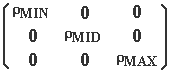

so that :
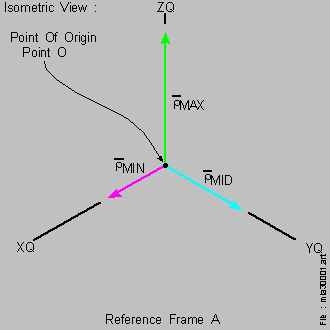
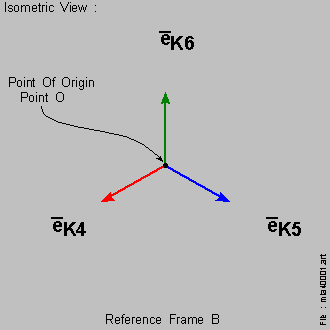
in { Reference Frame B } maps onto  , in the direction , in { Reference Frame A }
in { Reference Frame B } maps onto
, in the direction , in { Reference Frame A }
in { Reference Frame B } maps onto  , in the direction , in { Reference Frame A } , and
in { Reference Frame B } maps onto
, in the direction , in { Reference Frame A } , and
in { Reference Frame B } maps onto  , in the direction , in { Reference Frame A } ;
as per this pair of diagrams below :
 &
& 
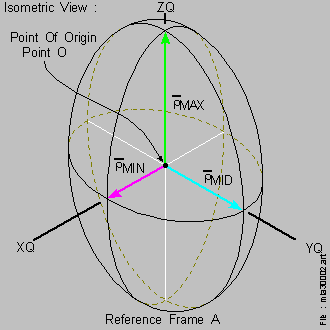
And we present also this pair of diagrams for better visualization purposes :
 &
& 
( same Set-Up as we have in { Section 4 } , initially. )
But we notice that there is { vector } on the { XQ-ZQ Plane } in { Reference Frame A } that has the exact-same length as , i.e. :
 as identified in the left-hand-side diagram below :
 &
& 
We then also identify the corresponding point, {  } in { Reference Frame B } on the right-hand-side diagram, so that :
 in { Reference Frame B } maps onto the vector in { Reference Frame A } .
The angles  &
&  , are then as marked in the diagrams above.
Let us now take a look at this diagram below for the 2-D view :

We then set up an angle  , whose value is given by :

Let us now rotate the entire { Ellipse } on the left-hand-side diagram ,
 } on the { Ellipse } ,
in a counter-clockwise direction, thru this angle , to arrive at this diagram below :

We note here that the vectors & are now aligned in the same direction .
And we present this diagram below for the 3-D view :
 &
& 
We then set up the final { linear mapping } relation for this Section, with :
in { Reference Frame B } mapping onto the vector  in { Reference Frame A } ,
in { Reference Frame B } mapping onto the vector
in { Reference Frame A } ,
in { Reference Frame B } mapping onto the vector  in { Reference Frame A } ,
in { Reference Frame B } mapping onto the vector
in { Reference Frame A } ,
in { Reference Frame B } mapping onto the vector  in { Reference Frame A } ;
as per this pair of diagrams below :
 &
& 
so that :


And the final { linear mapping } relation is then :


We then have three (3) { eigen-vectors } for this { linear mapping } relation :
in { Reference Frame B } mapping onto the vector in the direction in { Reference Frame A } ,
 ;
in { Reference Frame B } mapping onto the vector in { Reference Frame A } ,
;
;
in { Reference Frame B } mapping onto the vector in { Reference Frame A } ,
;
 &
& 
( We note here that, in the special case of { =  } for a particular set of {
  , ,
, ,  } ,
} ,
as we have already discussed in { Sectio 6 } previously. )
We then set up this pair of diagrams below, showing the { eigen-blackhole } via the { white-color planes } :
 &
& 
In the next Section, we shall be looking at a 4-D { eigen-blackhole } in a { 7-D Vector Space } .