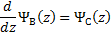
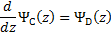
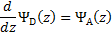
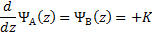
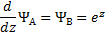
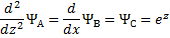
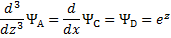
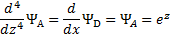
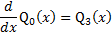
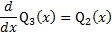
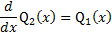
such that the 4 functions satisfy this { defining property } below , namely :
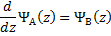


And this set of { 4 functions } is then known as { quad-symmetric based } functions simply because :
and the result will always be the same .
And it is to this extent that the { 4 functions } are { quad-symmetric } .

i.e. :
[ Psi-B ] and [ Psi-D ] are { additive conjugates } of one-another .
We can then write :
where [ K ] is the value of [ Psi-A ] and [ Psi-B ] at { [ z ] = [ Z-zero ] } .
Consequently :
arising from the { additive conjugate } relations we have above .
and all { derivatives } are therefore also [ zero ] .
No problems here as the circular { derivative relations } are always satisfied .


and so-on-and-so-forth , with the pattern [ +K , -K , -K, + K ] repeating itself ad infinitum .
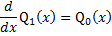

Let us now do a { Taylor Series } expansion here , via :
to yield :


And the consolidated format of these 4 equations is then :


And we simply note here that above format is the same format for the { Taylor Series } expansion for :


But more on this later in the next Section .
and consequently :


We then have :
or ,


and we have :


with these satisfying the original { defining property } for the { Quad-Symmetric Based } functions .
and ,