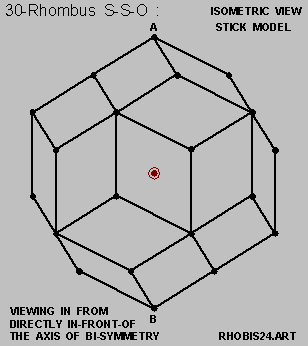
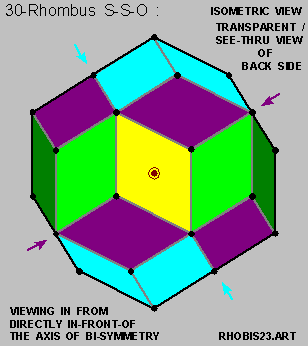
- the first set of 3 diagrams arising from the [ Third Attempt ] , and
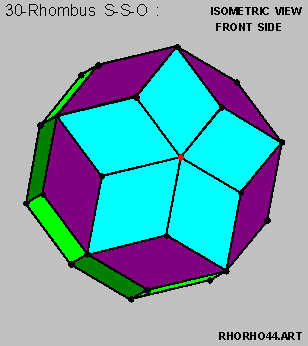
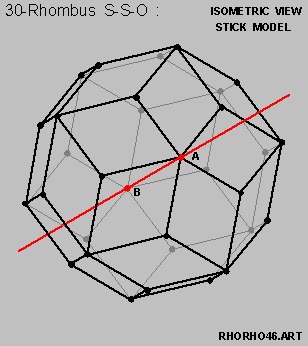
- the second set of 3 diagrams arising from the [ Second Attempt ] .
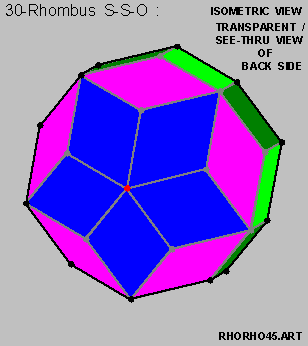

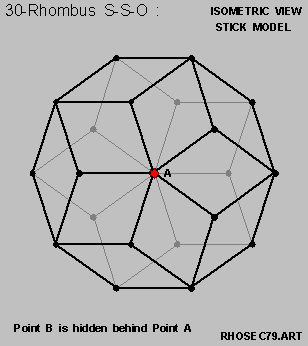

Question :
- do we see an [ axis of bi-symmetry ] here .
- as per this set of six (6) diagrams below .
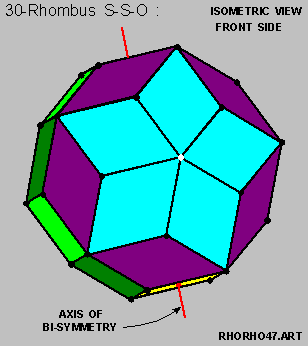
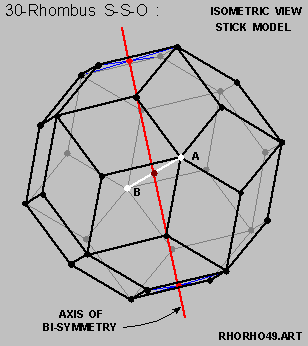
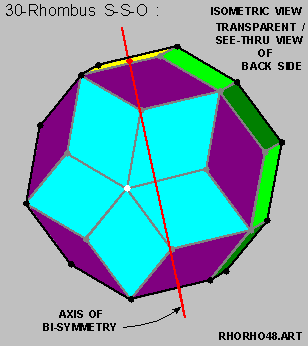
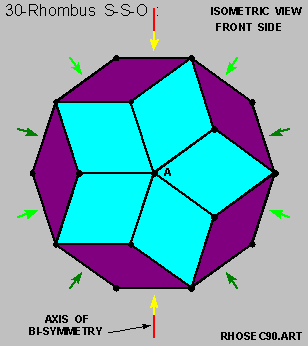
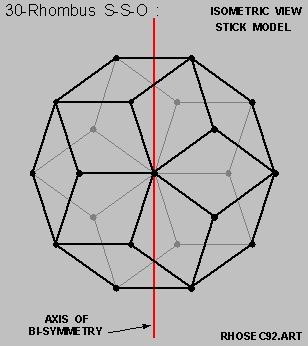
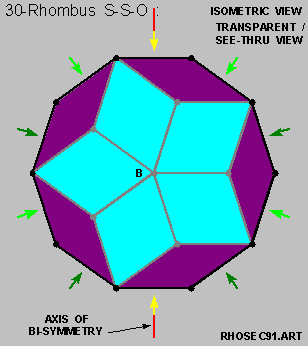
- any straight-line passing thru the centroids of a pair of [ opposite rhombuses ] on the [ 30-Rhombus S-S-O ]
- is an [ axis of bi-symmetry ] .
And in the above set of 6 diagrams ,
- when we rotate the [ 30-Rhombus S-S-O ] thru an angle of [ 180-degrees ] ,
- using the [ axis of bi-symmetry ] as marked-off in [ red-color ] as the [ axis-of-rotation ] ;
the following happens :
- the 2 rhombuses as marked-off in [ yellow-color ] do [ self-rotations about its centroid-point ] to retain the same posture ,
- the 10 rhombuses as marked-off in [ cyan-color ] exhange positions ,
- the 10 rhombuses as marked-off in [ purple-color ] exhange positions ,
- the 4 rhombuses as marked-off in [ light-green-color ] exhange positions ,
- the 4 rhombuses as marked-off in [ dark-green-color ] exhange positions ,
And the [ 30-Rhombus S-S-O ] will look exactly the same before-and-after the said [ 180-degrees rotation ] .