| TABLE OF CONTENT | |
|---|---|
| Topic #1 | Tri-Octo Symmetry |
| Topic #2 | Quad-Hexa Symmetry |
| Topic #3 | { 24-Structural Symmetry } |
| Topic #4 | Multiplex Logical Symmetry |
| Topic #5 | Concluding Remarks |
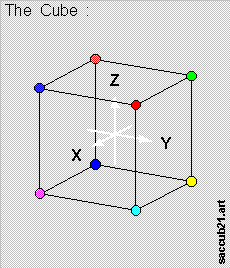
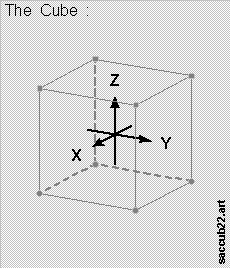
Let us first bring-in a 3-D { Cube } , as per the diagram on-the-left , below .
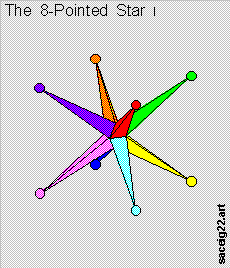
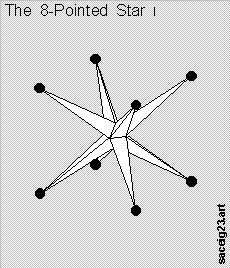
Let us now construct a { 8-Pointed Star } , using the 8 corners of the cube as the { points } , as per the diagram on-the-right , above .
Let us now rotate the { 8-Pointed Star } about the { [ -1, -1, -1 ] - [ +1, +1, +1 ] } axis ,
as per the set of 4 diagrams below .
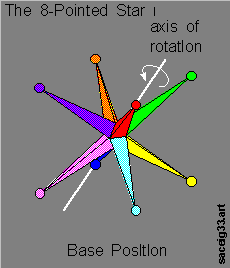
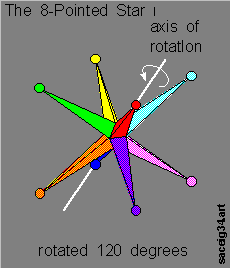
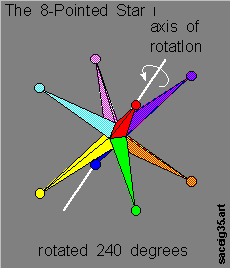
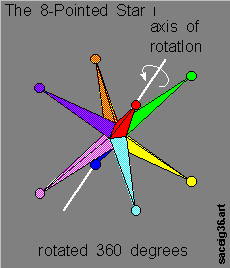
The { 8-Pointed Star } is therefore also [ Tri-Symmetric ] about 4 axis :
i.e. : the 4 cross-diagonals of the { Cube } .
Let us bring- in again a 3-D { Cube } , as per the diagram on-the-left , below .
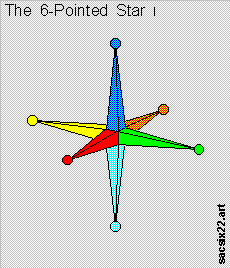
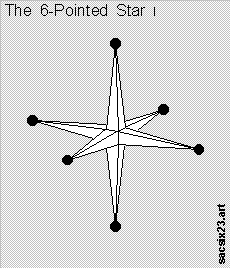
Let us now construct a { 6-Pointed Star } , using the 3 orthogonal [ axis-directions ] , as per the diagram on-the-right , above .
Let us now rotate the { 6-Pointed Star } about [ X-Axis ] ,
as per the set of 4 diagrams below .
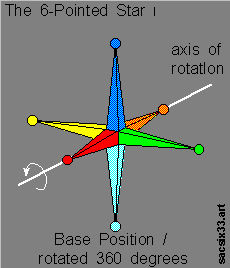
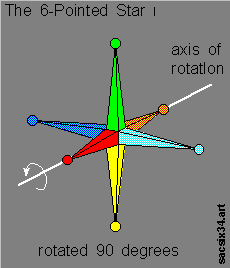
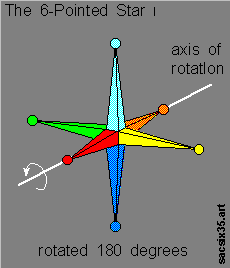
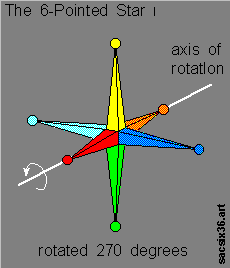
The { 6-Pointed Star } is therefore also [ Quad-Symmetric ] about 3 axial-directions , i.e. :
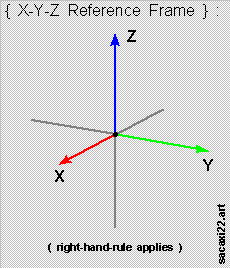
Let us now bring-in a { X-Y-Z Reference Frame } , as per the diagram on-the-left , below :
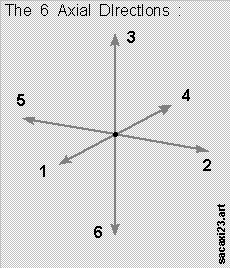
Let as also identify six (6) fixed directions , as per diagram on-the-right , above , for mapping purposes .
There are then 24 ways that we can orient the { X-Y-Z Reference Frame } , mapping onto these 6 fixed-directions ,
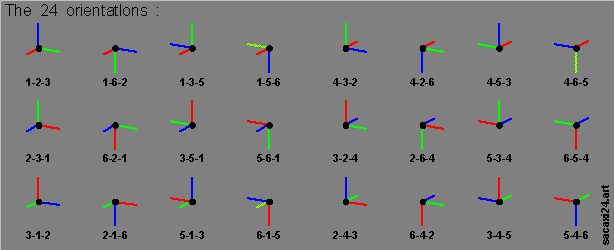
Let us suppose that :
IF we found that the shape of the object remains constant throughout ,
THEN the object is said-to-be [ 24-Structural Symmetric ] .
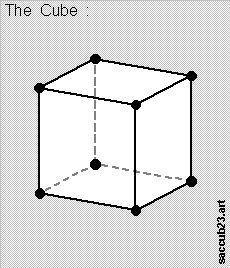
And we offer three (3) such objects with this special property :
Let us now identify a set of eight (8) separate colors for our use in this section , namely :
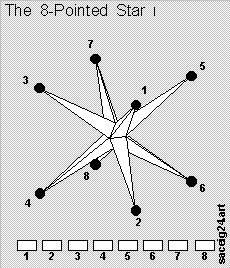
Let us now bring-in a blank { 8-Pointed Star } to be colored , as per the diagram on-the-left , below .
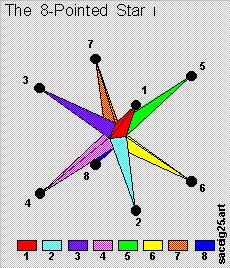
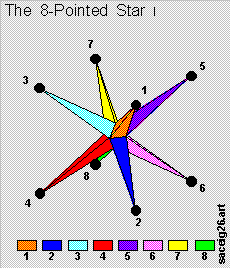
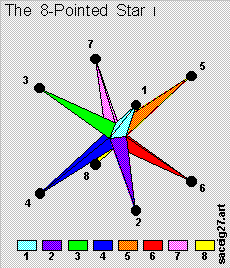
Let us now paint each of the 8 arms of the { 8-Pointed Star } a different color , as per the 3 examples in the 3 diagrams on-the-right , above .
We simply note here that there are 40,320 ways , or [ 8-factorial ] ways , to do this ,
And these 40,320 configurations are said-to-be [ Logically Symmetric ] , because :
Let us now add a little twist & spice , by coloring the 8 { nodal points } the same color as the arm ,
as per the diagram of-the-left , below , i.e. { Diagram LS-1 } .
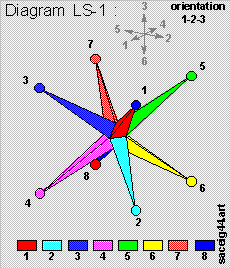
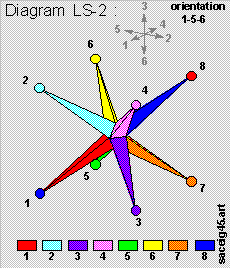
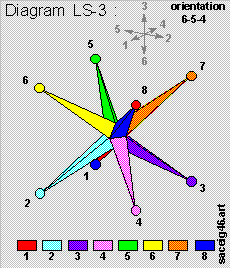
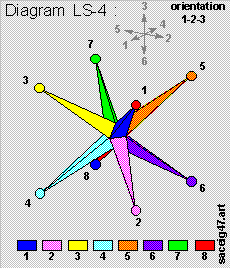
Let us now rotate the entire [ object ] about the { "1"-axis } , as marked { grey-color } ,
Let us again rotate the entire [ object ] about the { "2"-axis } , as marked { grey-color } ,
Let us now try to arrive the configuration in { Diagram LS-3 } via the [ logical ] route , i.e. :
changing the coloring-scheme to the one as per the bottom-row in { Diagram LS-4 } , above .
And the configurations in { Diagram LS-3 } & { Diagram LS-4 } are now the same . Interesting eh !
Let us try another configuration , as per the { Diagram LS-5 } on-the-left , below .
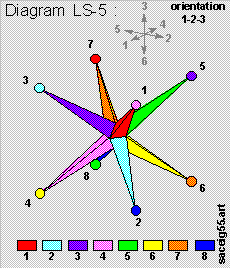
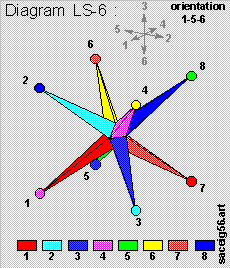
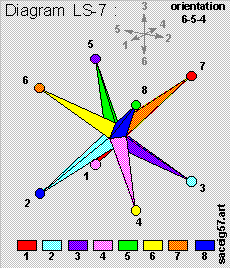
Let us now rotate the entire [ object ] about the { "1"-axis } , as marked { grey-color } ,
Let us again rotate the entire [ object ] about the { "2"-axis } , as marked { grey-color } ,
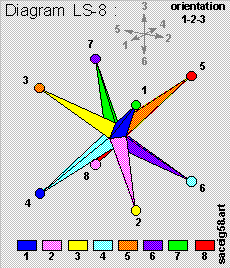
Let us now try to arrive the configuration in { Diagram LS-7 } via the [ logical ] route , i.e. :
changing the coloring-scheme to the one as per the bottom-row in { Diagram LS-8 } , above .
And the configurations in { Diagram LS-7 } & { Diagram LS-8 } are now the same .
( Hint : try the [ 1-4-6-7 tetrahedron ] symmetry vs. the [ 8-5-3-2 tetrahedron ] symmetry . )
We also note here , in passing , that :
Symmetry , sometimes , can be more deceptive than first-meet-the-eye .
The arithmetic equation for { Tri-Octo Symmetry } & { Quad-Hexa Symmetry } is quite naturally :
And we now make this observation :
and then moves-on to the 64 { Hexagrams } of 6-lines each ,
The "I-CHING" may , therefore , have been rooted in the study of symmetry & assymetry of geometric shapes ,
And more effort in this direction may be warranted .
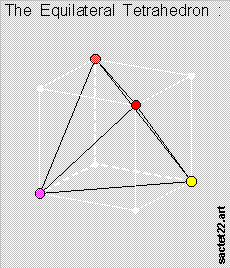
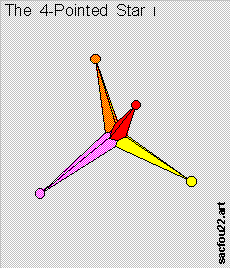
Finally , we bring-in the { Equilateral Tetrahedron } & the { 4-Pointed Star } :
( Three Body Problem / Characteristics of Numbers / Matrix & Linear Algebra / 'I-CHING' / Triangle / Odd-On-Odd Format / Multiplication Table for Modulo P )