Let us now bring back the [ 6-colors Configuration ] we have above :

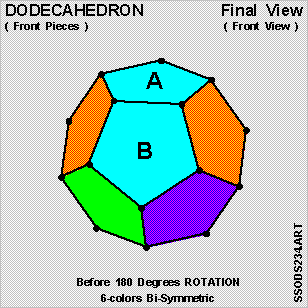

- And we have now marked-off the 2 [ cyan-color pieces ] as [ Piece A ] and [ Piece B ] respectively .
Let us now do a [ 180 degrees Rotation ] on the [ 6-colors Dodecahedron ] ,


We have therefore exchanged the positions of the 2 [ cyan-color pieces ] , i.e. [ Piece A ] and [ Piece B ] :
- but the [ 6-colors configuration ] for the { 6-colors Dodecahedron } remains the same .
Essentially , if we were to toss the { 6-colors Dodecahedron } into the air and it happens to land on a [ cyan-color piece ] :
- we would not be able to tell which of the two (2) [ cyan-color pieces ] it landed-on .


