SSO - Bi-Symmetry ( Icosahedron )
On Symmetric Structures within Symmetric Solid Objects
by Frank C. Fung ( 1st published in March, 2010. )
Section XX - The Bi-Symmetric Nature of the Icosahedron
Summary for the Section :
- In this Section , we shall investigate the Bi-Symmetric Nature of the Icosahedron .
The 10-colors { Bi-Symmetric Configuration } :
The Construction Process for the { 10-colors Configuration } :
- STEP 1 :
We first identify any pair of 2 adjacent [ pieces ] and color these the [ 1st-Color ] ( cyan ) , and :
- we also color the two (2) [ pieces ] directly-opposite to these 2 [ pieces ] the [ 2nd-Color ] ( cornflower-blue ) .
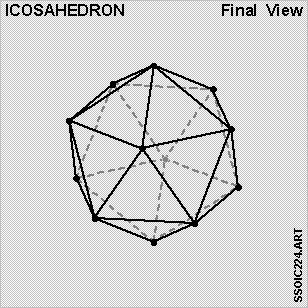


Let us now also take this opportunity to identify the [ Axis-Of-Bi-Symmetry ] for our later use below , via :
- First identifying the [ mid-point ] on the edge common to the 2 [ cyan-color pieces ] as the point [ Point Q1 ] ;
- Secondly , identifying the [ mid-point ] on the edge common to the 2 [ cornflower-blue-color pieces ] as the point [ Point Q2 ] .


- We then construct a straight-line passing-thru the two (2) points , [ Point Q1 ] and [ Point Q2 ] respectively , and :
- this then is the [ Axis-Of-Bi-Symmetry ] for our current { 10-colors Configuration } .
STEP 2 :
In order to maintain the Bi-Symmetric nature of the 2 [ cyan-color pieces ] , we must now necessarily :
- color the 4 [ pieces ] each adjacent to one of the 2 [ cyan-color pieces ] } , the [ 3rd Color ] ( red ) and the [ 4th Color ] ( magenta ) ,
- in the crisscross pattern as shown below .
And , in order to maintain the Bi-Symmetric nature of the 2 [ blue-color pieces ] , we must now necessarily :
- color the 4 [ pieces ] each adjacent to one of the 2 [ cornflower-blue-color pieces ] } , the [ 5th-Color ] ( orange ) and the [ 6th Color ] ( brown ) .
- in the crisscross pattern as shown below .

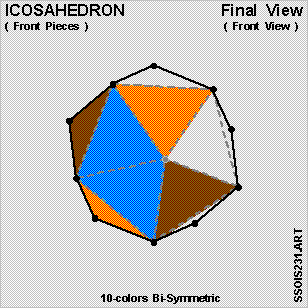
Step 3 :
In order to maintain the Bi-Symmetric nature of the 2 [ cyan-color pieces ] , we must now necessarily :
- color the 2 [ pieces ] situated in-between each of the { [ red-color piece ] - [ magenta-color piece ] duo } the 7th Color ( purple ) .
And , in order to maintain the Bi-Symmetric nature of the 2 [ cornflower-blue-color pieces ] , we must now necessarily :
- color the 2 [ pieces ] situated in-between each of the { [ orange-color piece ] - [ brown-color piece ] duo } the 8th Color ( yellow ) .


Step 4 :
For the 4 remaining [ pieces ] , we shall now use a [ Bi-Polar coloring scheme ] on these 4 [ pieces ] ,
- involving the [ 9th Color ] ( light-green ) and the [ 10th Color ] ( dark-green ) .


This then permits for the Bi-Symmetric nature of both :
- the [ 2 cyan-color pieces ] , and
- the [ 2 cornflower-blue-color pieces ] ;
to be maintained .
The Analysis on Bi-Symmetry :
- Let us now bring back the [ 10-colors Configuration ] we have above :


- And we have now marked-off the 2 [ cyan-color pieces ] as [ Piece A ] and [ Piece B ] respectively .
Let us now do a [ 180 degrees Rotation ] on the [ 10-colors Icosahedron ] ,

We have therefore exchanged the positions of the 2 [ cyan-color pieces ] , i.e. [ Piece A ] and [ Piece B ] :
- but the [ 10 colors configuration ] for the { 10-colors Icosahedron } remains the same .
Essentially , if we were to toss the { 10-colors Dodecahedron } into the air and it happens to land on a [ cyan-color piece ] :
- we would not be able to tell which of the two (2) [ cyan-color pieces ] it landed-on .
- We also take note , at this point , that via the { 180 Degrees Rotation } above :
As such , if we were to toss the { 10-colors Icosahedron } into the air and it happens to land on any one of these 9 colors :
- we also would not be able to tell which of the 2 [ same-color-pieces ] the Icosahedron landed-on .
- We have therefore achieved [ Bi-Symmentry ] for all ten (10) colors for this particular { 10-colors configuration } of the Icosahedron .
A Quick Question :
Original dated 2010-3-31

