- each pair of faces directly oppoiste to one-another are painted the same color .


We then have the resultant { 4-colors Octahedron } as shown below :


- the diagram on-the-left is the [ Front View ] ,
- the diagram in-the-middle is the [ Transparent View ] , and
- the diagram on-the-right is the [ Back View ] .

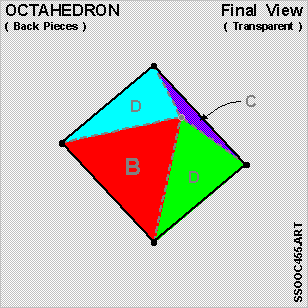

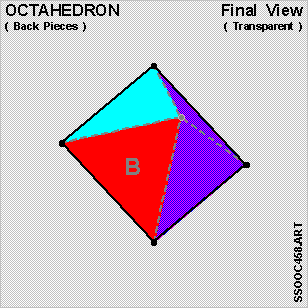
- And we have now marked-off the two [ red-color pieces ] as [ Piece A ] and [ Piece B ] , respectively , as shown above .
- the 3 [ pieces ] adjacent to [ Piece A ] , marked-off with the letter [ C ] , are green-cyan-purple in color , and :
- the [ circular counterclockwise rotation-order ] for the 3 pieces is [ green - cyan - purple ] .
- the 3 [ pieces ] adjacent to [ Piece B ] , marked-off with the letter [ D ] , are green-purple-cyan in color , and :
- the [ circular counterclockwise rotation-order ] for the 3 pieces is then [ green - purple - cyan ] .
We see here immediately that :
- the { [ circular counterclockwise rotation-order ] for the [ 3 adjacent pieces ] } are different for [ Piece A ] and [ Piece B ] .
- we would be able to tell [ Piece A ] from [ Piece B ] because of the color-configuration difference in their [ 3 adjacent pieces ] .
As such , this { 4-colors Octahedron } cannot possibly be Bi-Symmetric in nature .