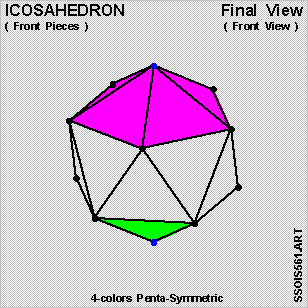
And , in order to understand why this [ configuration ] here is indeed Penta-Symmetric :
We first set up the [ Axis-Of-Penta-Symmetry ] for our [ 4-colors Configuration ] here , via :

We then color the five (5) [ pieces ] touching on [ Point Q1 ] the [ 1st Color ] ( magenta ) , and

In order to maintain the Penta-Symmetric nature of the 5 [ magenta-color pieces ] , we must now necessarily :
And , in order to maintain the Penta-Symmetric nature of the 5 [ green-color pieces ] , we must now necessarily :

This then completes our Construction Process here .

Let us now do a successive of five (5) [ 72-Degrees Rotations ] on the [ 4-colors Icosahedron ] ,
Thus , we have now achieved Penta-Symmetry for the 5 [ magenta-color pieces ] .
Essentially , if we were to toss the { 4-colors Icosahedron } into the air and it happens to land on a [ magenta-color piece ] :
but the [ overall 4-colors configuration ] for the { 4-colors Icosahedron } would have remained the same .
As such , if we were to toss the { 4-colors Icosahedron } into the air and it happens to land on any one of these 3 colors :
Very simply , there are twelve (12) [ nodal-points ] to a Icosahedron , so that :