


And , in order to understand why this [ configuration ] here is indeed Quad-Symmetric :
- we shall now identify a set of 3 { Bi-Symmetric Axis } to guide us thru the analysis , below .
And , in order to understand why this [ configuration ] here is indeed Quad-Symmetric :
We first identify the [ mid-point ] on the common edge of each individual-pair of the 2 pairs of { adjacent [ cyan-color pieces ] } :


We then set up a straight-line passing thru the 2 said points , and :
We first identify the [ mid-point ] on the common edge of each individual-pair of 2 pairs of { adjacent [ orange-color pieces ] } :


We then set up a straight-line passing thru the 2 said points , and :
We first identify the [ mid-point ] on the common edge of each individual-pair of 2 pairs of { adjacent [ light-green-color pieces ] } :


We then set up a straight-line passing thru the 2 said points , and :
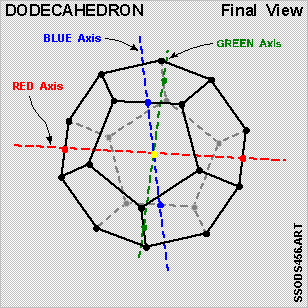


First Property :
This is because each pair of directly-opposite edges are always [ bi-polar ] in nature , so that :
As such , the [ centroid ] is common to all 3 Axis and is , in fact , the [ point-of-intersection ] for the 3 [ Axis ] .
Second Property :
This is because the Dodecahedron is [ 12-Symmetric ] and our 3-colors { coloring scheme } here does allow for :
As such , each pair of [ axis ] must necessarily intersect one-another at [ right-angles ( 90-Degrees-Angles ) ] .


Let us now do a [ 180 degrees Rotation ] on the { [ 3-colors Dodecahedron ] in the [ Base Position ] } ,
And by doing so , we would have :
Let us now do a [ 180 degrees Rotation ] on the { [ 3-colors Dodecahedron ] in the [ Base Position ] } :
And by doing so , we would have :
Let us now do a [ 180 degrees Rotation ] on the { [ 3-colors Dodecahedron ] in the [ Base Position ] } :
And by doing so , we would have :
Thus , we can now conclude that the 4 [ cyan-color pieces ] are indeed freely interchangeable in nature .
Very simply , there are thirty (30) [ edges ] to a Dodecahedron , so that :