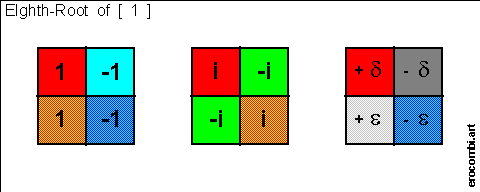
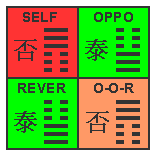
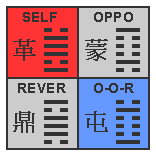
then each of the following 3 sets , i.e. the sets :
,
,
;
would each exhibit a different and distinct { combinatorics-symmetry pattern } .

where [ P ] is an { odd prime number } and [ a ] is a { positive integer } less than [ P ] .
We then bring-in an extension thereof previously discussed in { Approach to the Characteristics Of Numbers } , namely :
and the equation :
has solutions , other than [ 1 ] , if and only if [ R ] is divisible into [ Q ] .
has solutions other than [ 1 ] .
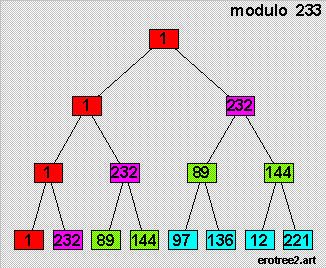
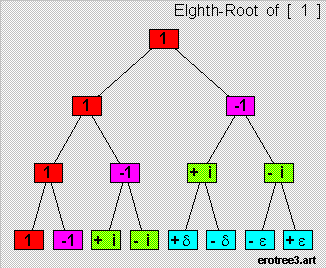
We then bring-in this { tree-diagram } on-the-left , below , to give the 8 { roots } :

and look at an equation of similar format , modelled therefrom , for the diagram on-the-right :
We then have :
yielding the relation :
We then bring-in this diagram for the 3 sets , i.e. the sets :
,
,
;
whereby :

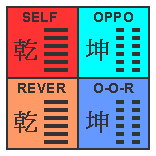
Let us now bring-in this set of 3 diagrams from { An Approach to the I-CHING } ,

CLEARLY , each of the 3 sets shows a different and distinct { combinatorics-symmetry pattern } .

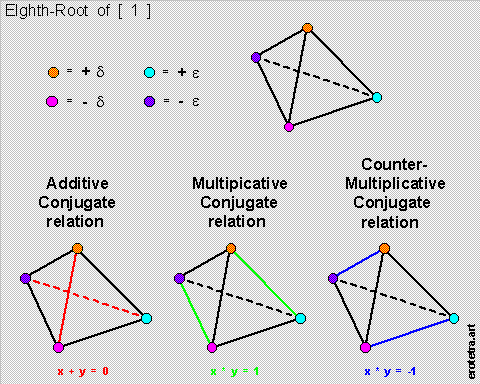
at the 4 vertices of an { equilateral tetrahedron } , as per this diagram below :

We see here that each pair of opposite edges would then depict a different { conjugate relation } :
Seems likely that all three are always all-important .
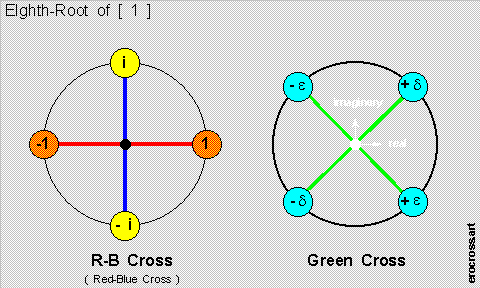
in the { imaginary plane } , on the right-hand-side .

is always superior to using the { Green Cross } on-the-right ?
May be not . And we shall leave this for the reader's further evaluation .