

| Topic I | The { 'YIN Line' } and the { 'YANG Line' } |
| Topic II | Trigrams |
| Topic III | Hexagrams |
| Topic IV | Brief History of the 'I-CHING' |
| Topic V | Trigram Positioning according to FU XI |
| Topic VI | Trigram Positioning according to WEN WANG |
Before you can detect a { CHANGE } , you must first recognize a [ difference ] .
In the 'I-CHING', the [ difference ] is expressed via the a pair of 'opposite' symbols --- the { 'YIN Line' } vs. the { 'YANG Line' } :
In general,
 or { 'YIN' } , represents 'Darkness', 'Coldness', the 'Negative', the 'Passive', etc.,
 or { 'YANG' } , represents 'Brightness', 'Warmth' , the 'Positive', the 'Active', etc..
A Trigram is simply a set of three (3) { 'YIN' or 'YANG' Lines } , arranged in a vertical order.
The eight (8) Trigrams, are as follows :
| Tri- gram | Name of Trigram | Assigned Meaning | the 'ICG' designation | |
|---|---|---|---|---|
| 1 |  |  - qian - qian |  - heaven - heaven | T1 |
| 2 |  |  - dui - dui |  - lake - lake | T2 |
| 3 |  |  - li - li |  - fire - fire | T3 |
| 4 |  |  - zhen - zhen |  - thunder - thunder | T4 |
| 5 |  |  - xun - xun |  - wind - wind | T5 |
| 6 |  |  - kan - kan |  - water - water | T6 |
| 7 |  |  - gen - gen |  - mountain - mountain | T7 |
| 8 |  |  - kun - kun |  - earth - earth | T8 |
And a Trigram is always read from the bottom-line upwards, as per this example below :

A Hexagram is simply a set of six (6) { 'YIN' or 'YANG' Lines } , arranged in a vertical order.
And a Hexagram is often viewed as [ one Trigram stacked on-top-of another Trigram ] :
 /
/ 
 /
/ 
We then have a listing of the 64 Hexagrams as per the table below :
| Upper Trigram | ||||||||||
|---|---|---|---|---|---|---|---|---|---|---|
|
|
|
|
|
|
|
|
|||
| T1 | T2 | T3 | T4 | T5 | T6 | T7 | T8 | |||
| L o w e r T r i g r a m |
|
T1 |  |
 |
 |
 |
 |
 |
 |
 |
|
T2 |  |
 |
 |
 |
 |
 |
 |
 |
|
|
T3 |  |
 |
 |
 |
 |
 |
 |
 |
|
|
T4 |  |
 |
 |
 |
 |
 |
 |
 |
|
|
T5 |  |
 |
 |
 |
 |
 |
 |
 |
|
|
T6 |  |
 |
 |
 |
 |
 |
 |
 |
|
|
T7 |  |
 |
 |
 |
 |
 |
 |
 |
|
|
T8 |  |
 |
 |
 |
 |
 |
 |
 |
|
And the names of the 64 Hexagrams in Chinese ( Traditional Chinese Characters ) , are as per the table below :
| Upper Trigram | ||||||||||
|---|---|---|---|---|---|---|---|---|---|---|
|
|
|
|
|
|
|
|
|||
| T1 | T2 | T3 | T4 | T5 | T6 | T7 | T8 | |||
| L o w e r T r i g r a m |
|
T1 |  |
 |
 |
 |
 |
 |
 |
 |
|
T2 |  |
 |
 |
 |
 |
 |
 |
 |
|
|
T3 |  |
 |
 |
 |
 |
 |
 |
 |
|
|
T4 |  |
 |
 |
 |
 |
 |
 |
 |
|
|
T5 |  |
 |
 |
 |
 |
 |
 |
 |
|
|
T6 |  |
 |
 |
 |
 |
 |
 |
 |
|
|
T7 |  |
 |
 |
 |
 |
 |
 |
 |
|
|
T8 |  |
 |
 |
 |
 |
 |
 |
 |
|
And the name-pronunciations of the 64 Hexagrams in Chinese phonetics ( Putonghua Phonetics ) , are as per the table below :
| Upper Trigram | ||||||||||
|---|---|---|---|---|---|---|---|---|---|---|
|
|
|
|
|
|
|
|
|||
| T1 | T2 | T3 | T4 | T5 | T6 | T7 | T8 | |||
| L o w e r T r i g r a m |
|
T1 | qian | guai | da you |
da zhuang |
xiao xu |
xu | da xu |
tai |
|
T2 | lu | dui | kui | gui mei |
zhong fu |
jie | sun | lin | |
|
T3 | tong ren |
ge | li | feng | jia ren |
gei ji |
bi | ming yi |
|
|
T4 | wu wang |
sui | shi |
zhen | yi | tun | yi | fu | |
|
T5 | gou | da guo |
ding | heng | xun | jing | gu | sheng | |
|
T6 | song | kun | wei ji |
jie | huan | kan | meng | shi | |
|
T7 | dun | xian | lu | xiao guo |
jian | jian | gen | qian | |
|
T8 | fou | cui | jin | yu | guan | bi | bo | kun | |
We have marked in this table, ( in darker-colors and in pairs ) , the Hexagrams whose pronunciations are very similar in Chinese ( Putonghua / Mandarin ) .
Thus, identifying the 64 Hexagrams via [ citing their names only ] may often lack the precisions required.
In the [ ICG Approach ] , we shall identify each Hexagram :
EITHER :
OR :
e.g. : the Hexagram { HEAVEN } , , will be designated as [ T1-T1 ] .
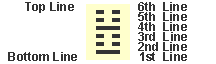
We note here that a Hexagram is also always read from the bottom upwards, as per this example below :
The 'I-CHING' was created early in Chinese history and the three (3) relevent periods are :
| 1. | XIA Dynasty |  | - circa [ 21th Century B.C. ] to [ 16th Century B.C. ] |
| 2. | SHANG Dynasty |  | - circa [ 16th Century B.C. ] to [ 1066 B.C. ] |
| 3. | ZHOU Dynasty |  | - circa 1066 B.C. to 256 B.C. |
 , or FU XI , the legendary author of the 8 Trigrams, lived in the times before the [ XIA Dynasty ] .
And there are three (3) versions of the 'I-CHING' :
 : The 1st version was the { Connedcted-Hill-I } in the [ XIA Dynasty ] .
 : The 2nd version was the { Return-Hidden/Treasure-I } in the [ SHANG Dynasty ] .
 : The 3rd version was the { ZHOU-I } in the [ ZHOU Dynasty ] .
 , or WEN WANG ( King Wan ) , the author of the { ZHOU-I } , is the father of the founding king of the [ ZHOU Dynasty ] ,
Several things to note here :
 to Chinese Characters
  .
.
Authenticity & interpretation may always be problems here.
- MOUNTAIN was the first-listed Trigram in the [ Connected-Hill-I ] ,
- EARTH was the first-listed Trigram in the [ Return-Hidden/Treasure-I ] ,
- HEAVEN is the first-listed Trigram in the [ ZHOU-I ] .
Each version of the 'I-CHING' therefore took on a slightly different emphasis.
 ) and the readings therefrom are interpreted thru the 'I-CHING' .
The 'I-CHING' is therefore an integral part of early Chinese Life, Culture & History.
 , or Confucius ( circa 511 B.C. - 479 B.C. ) have added his thoughts on the 'I-CHING' in his writings, the [ Ten Wings ] (
  ) .
) .
And these are usually included as part of the 'I-CHING' .
The Trigram Positioning Diagram below, is usually attributable to FU XI :
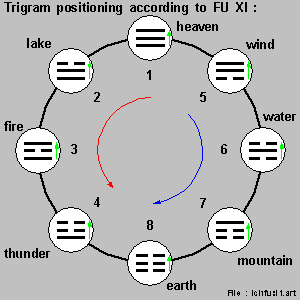
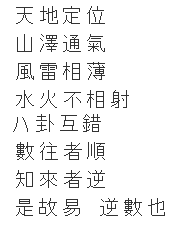
And the 'sayings' on the right are usually associated with this diagram.
And a translation is as follows :
And we shall come back to this all-important diagram in later Sections.
The Trigram Positioning Diagram below, is usually attributable to WEN WANG :

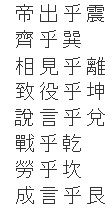
And the 'sayings' on the right are usually associated with this diagram.
And a translation is as follows :
And we shall also come back to this all important diagram, including the numbers, in later Sections.