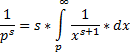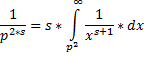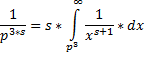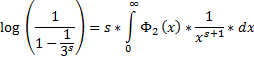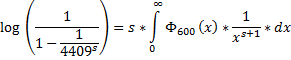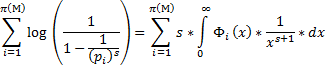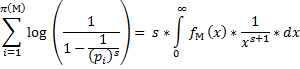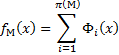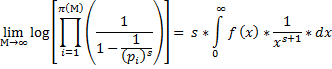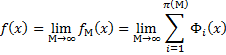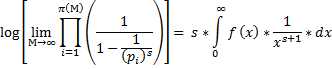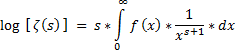
As such , the [ f(x) Function ] , being the summation result thereof ,
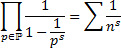
We can then re-write each individual term on the left-hand-side in this format :
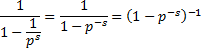
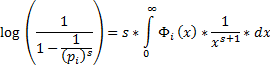
And on [ taking-logarithms ] , we have :
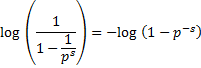
On applying this to the equation above then yields :

And on applying these to the equation we have above then yield us this , for an individual term on the left-hand-side of the Euler Observation :


And on re-arranging , we have :

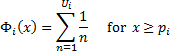
where the [ PHI-i-of-(x) ] function is a { step function } associated with that particular { prime number } [ p-i ] .
Let us now look at this [ PHI-i-of-(x) ] function more closely , next .
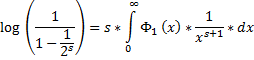
Thus , we can write :
And the properties for the { step function } [ PHI-1-of-(x) ] are as follows :
Thus , we can write :
And the properties for the { step function } [ PHI-2-of-(x) ] are as follows :
Thus , we can write :
And the properties for the { step function } [ PHI-600-of-(x) ] are as follows :
And based on our understanding of the [ PHI-i-of-(x) ] { step functions } above , we can now write :
yielding :
where :
yielding :
where :
This then leads us to this equation :
and finally yielding :
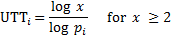
We then define the [ UTT-i ]'s via :
[ UTT-i ] is then the quotient of { log [ x ] } over { log [ p-i ] } ;

And by following closely / almost-exactly the procedure we have outlined for the [ QTT-i ]'s in Section IV ,
And this equation tells us that :
otherwise we would have gone beyond [ x ] and brought-in extra-unwanted-terms .
and :
noting here that the [ PHI-i-of-(x) ] is , by its nature , the sum of the [ reciprocals ] up to the value [ U-i ] .
it then follows that :
also only [ jumps / changes value ] :