We shall also introduce / propose an { Inequality } :

or alternately :
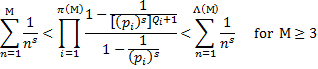
labeled as the { Fung Inequality } , for-the-time-being , for identification purposes .
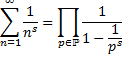
We shall also introduce / propose an { Inequality } :
or alternately :

labeled as the { Fung Inequality } , for-the-time-being , for identification purposes .
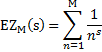
On expansion for [ M = 31 ] , we have :




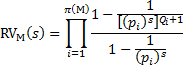
On expansion for [ M = 31 ] , we have :
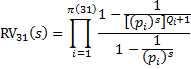
This then yields this equation :



so that , we would expect to have , on full expansion :
And indeed , on full expansion , we have :


As such , we can now write :


And the derivation here can follow along-the-same-lines as we have just outlined above .
And this smallest term is given by :

or simply :
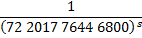
And the smallest term here is always given by the product of the { smallest term in each of the 11 brackets } in the original equation .
We note here that the number in the { denominator } above is in fact the { L.C.M. of natural numbers from [ 2 ] to [ 31 ] } :

And this is always the case because of our specific design of the [ RVM-of-(s) ] function .
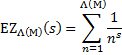
Let us now do an expansion of this function for [ M = 31 ] and we have :


Two (2) things to note here :

As such , we can now write :


Again, the derivation here can follow along-the-same-lines as we have just outlined above .
And we shall refer to this as the { Fung Inequality } , for-the-time-being , for identifcation purposes .
And this is because :
the term in-the-middle , being bounded to-the-left and to-the-right , must also converge to the same limit .


And on full expansion , this then becomes :
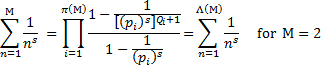

we come up with this rather simple equation :
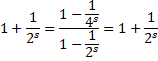
But this is indeed a most-important equation , explained as follows :
and these 3 functions always meet and share the exact-same [ complex value ] at [ M = 2 ] ,
The question then arises :
or alternately :