where :
- on the left-hand-side : [ p ] is each a { prime number } ,
- on the right-hand-side : this involves all { natural numbers } .
- whenever the two (2) sides converge , he shall call it the { Zeta Function } .
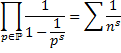
where :
The remainder of Riemann's paper is primarily concerned with the half-plane :

Our proposals below , for both the left-hand-side and the right-hand-side , will follow suit :
or :
before we let the value of [ M ] move-out towards [ infinity ] to arrive at the original left-hand-side above .
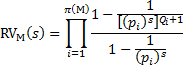
And the expansion here is via { geometric series with a finite number of terms } , i.e. :

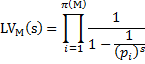
And the expansion here is via { geometric series with an infinite number of terms } , i.e. :

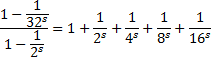
And the value here is a [ finite value ] , complex or otherwise .

Again the value here is a [ finite value ] , complex or otherwise .
In fact , for any given { finite prime number } [ p-i ] :
As such , when we use either the [ RVM-of-(s) ] or the [ LVM-of-(s) ] function for the Left-Hand-Side , i.e. :
or :
we do end up with a [ finite value ] , complex or otherwise , for the entire function ,
as long the value of [ M ] remains finite .
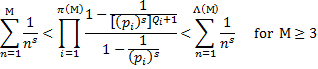

But this equation also says this :
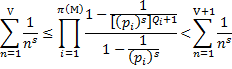
And the value [ V ] is in-between [ M ] and [ Lamda-of-(M) ] , i.e. governed by :


then :