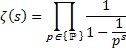
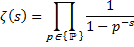
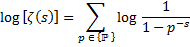
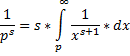
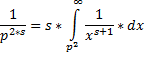
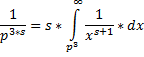
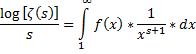
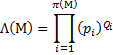
- For the value of [ x ] not being equal to a { prime number } :
- For the value of [ x ] being equal to a { prime number } :

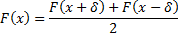

Very simply , F(x) is a { step-function } with a jump whenever the value of [ x ] is a { prime number } .
- { F(x) = 0 } for { [ x ] being less than [ 2 ] } ,
- arising from the fact that [ 2 ] is the first-and-smallest { prime number } ;
- each jump at a { prime number } adds [ 1 ] to the value of Function F(x) .