- the section of the { complex plane } where :
This will then involve two (2) stages :
- the 1st Stage involving the munipulation of the { PI function } , and
- the 2nd Stage being the extension process itself .

This will then involve two (2) stages :
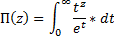
( This is the [ Big PI function ] related to the { Factorial Functions } ) .
Let us now replace the variable [ t ] in the { integrand } on the right-hand-side by the term [ n * x ] , i.e. we simply let :

where [ n ] is treated as if it is constant within the { integrand } , so that :

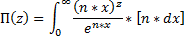
yielding :
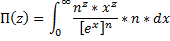
Collecting terms then yield this equation :
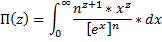
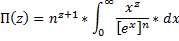
or ,
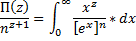
Let us now use a different { dummy variable } [ s ] , instead of [ z ] , in the above equation , via the relation :

and the above equation then becomes :
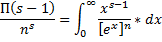
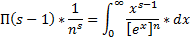
and we are now ready for the next stage in the development process .

with [ V ] here being a { positive integer } in-between [ 2 ] and [ infinity ] .
And summing-up both sides from [ n = 1 ] to [ n = V ] would then give us this equation below :
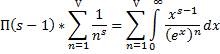
yielding consequently :
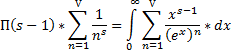
Let us now put the equation into this format :

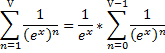
Applying the general formula for the summation of { geometric series } then yields us this equation :
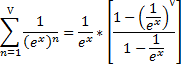
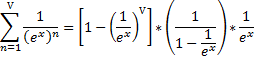
And on consolidating terms , we have :
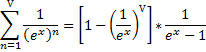

Re-arranging terms then yield us the same equation in this format :

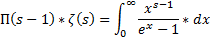
We see here this equation is different from the very-last we have above , i.e. the euqation :
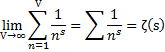
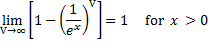
and :
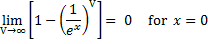
We simply wish to point out here that :