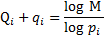
[ QTT-i ] is then the quotient of [ log M ] divided by [ log p-i ] ;

And the { fractional part } is , as always , governed by its defining relation , i.e. :
Thus, we can now write this new relation :
We can then write :
yielding :
And consequently , we also have :
As such , we can now write this inequality :
And this equation is valid as long as :
into the inequality immediately above , we can now write :
And this is our Bread-And-Butter Inequality , ready for our use in the next Section and beyond .
where [ p-j ] is that particular { prime number } in-question .
And the above Bread-And-Butter Inequality , under such circumstances , can be split into two (2) separate inequalities , namely :
and :
And the above Bread-And-Butter Inequality , under such circumstances , becomes :
for all the [ p-i ]'s .
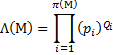
The calculation of the [ Lamda-of-(M) ] must , therefore accordingly , follow along these guide-lines :
where [ Q-i ] is the { appropriate-power } for the { prime number } [ p-i ] .
And that is to say :
And this tell us that the value of the L.C.M. only changes ,