
where [ pi-of-(M) ] is the { prime counting function } .
where [ pi-of-(M) ] is the { prime counting function } .

yielding the simple relation :

Rather simple indeed .

Noting that the Bread-And-Butter Inequality is valid for each and every one of these { prime numbers } , we can now write :
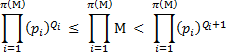
with the left-hand-side here being the [ product ] of these { prime numbers [ p-i ]'s raised-to-the-power [ Q-i ] } .
Thus , we have :
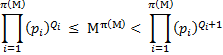

And this arises from the fact that :

so that the above inequality then becomes , for [ M = 2 ] :

which is trivial .

And this is based on these points raised in our discussions in the last Section :

with the only exception here being that :
then this equation below is valid :

for that particular { prime number } [ p-j ] in-question .
Since a minimum two (2) { prime numbers } are always involved whenever [ M ] is greater than or equal to [ 3 ] :
is valid , under the circumstances , at least [ one-time ] or [ more than one-time ] ;
can either be valid for [ one-time only ] or alternately [ not-applicable-at-all ] ,
As such , when we look at all the terms under the [ product sign ] here ,
( It actually takes only one [ less-than sign ] here to override all the other [ equal-to signs ] ,
For the Left-hand-side , the term here is in fact the L.C.M. , i.e. :

For the right-hand side , this may be expressed via the following :
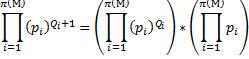
yielding :
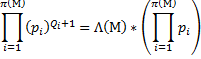
( The term on-the-very-right is then the { product-of-primes up to [ M ] } ) .
