
and we were able to find a set of values [ L2 , L3 ] , and a corresponding scalar value  , such that :

Then is the { eigenvalue } and { eigen-vector } is :
We note here that [ -L2 , -L3 ] is also always an { eigne-vector } , i.e. :

| Topic I | Introduction & Summary for this Section |
| Topic II | Defining { Eigen-vectors } |
| Topic III | Setting up the { Global Reference Frame } |
| Topic IV | Mapping Circles onto Circles |
| Topic V | Mapping Circles onto Ellipses |
| Topic VI | Quick Recap |
In this section, we shall be looking at { eigen-vectors } & { eigen-values } in 2-Dimensional Planar Mapping.
Our findings here are :
( The reader should be familiar with the mechanics of 2-D Planar Mapping , as presented in Appendix B , before moving-on in this Section .)
If we were able to identify, in a { linear mapping } relation, a vector such that it maps onto a vector in the same direction, then that particular vector is known as an { eiger-vector } for the { linear mapping } relation .
Let us look at a brief example here :
and we were able to find a set of values [ L2 , L3 ] , and a corresponding scalar value , such that :
Then is the { eigenvalue } and { eigen-vector } is :

We note here that [ -L2 , -L3 ] is also always an { eigne-vector } , i.e. :
Let us first set up the { Global Reference Frame } , identified by the orthogonal { unit-vectors }  &
&  respectively, as per this diagram below :

The { Global Reference Frame } shall then be fixed and constant throughout our analysis in this Section.
Let us also set up { Refence Frame A } & { Refernce Frame B } , so that :

 &
&  in { Reference Frame A } maps exactly onto the { unit-vectors } & in the { Global Reference Frame } , respectively ,
 &
&  in { Reference Frame B } maps exactly onto the { unit-vectors } & in the { Global Reference Frame } , respectively .
Let us first look at a specific { linear mapping } relation where a { circle } is mapped onto a { circle } .
We then have two (2) possible cases here :
In this case, we have the two (2) orthogonal { unit-vectors } & in { Reference Frame B } mapping onto the two (2) orthogonal vectors  &
&  in { Reference Frame A } , in the & directions , respectively :
as per this diagram below :

We then have the { unit-circle } in { Reference Frame B } mapping onto a { Circle } in { Reference Frame A }, as per this diagram below :

Any point { Point W } on the { unit-circle } in { Reference Frame B } then maps onto a corresponding point { Point P } on the { Circle } in { Reference Frame A } , so that :
 and the vector
  are the same ,
because the angle  is always equal to the angle
  when we map { circles } onto { circles } .
( see technical details in Case Three & Case Four below . )
Every vector on the { unit-circle } is then an { eigen-vector } under the circumstances.
In this case, we have the two (2) orthogonal { unit-vectors } & in { Reference Frame B } mapping onto the two (2) orthogonal vectors  &
&  in { Reference Frame A } , but in orthogonal directions other than the & directions , respectively :
as per this diagram below :

We then also have the { unit-circle } in { Reference Frame B } mapping onto a { Circle } in { Reference Frame A }, as per this diagram below :

Any point { Point W } on the { unit-circle } in { Reference Frame B } then maps onto a corresponding point { Point P } on the { Circle } in { Reference Frame A } , so that :
and the vector are not the same ,
because, while the angle continues to be equal to the angle , the said orientations now differ by an angle  , as per the diagram above.
( see technical details in Case Three & Case Four below . )
There are then no { eigen-vectors } under the circumstances, on the { unit-circle } or otherwise, in { Reference Frame B } .
Let us now look a { linear mapping } relation, where a { unit-circle } in { Reference Frame B } is mapped onto an { ellipse } in { Reference Frame A } .
Again, there are two (2) possibilities :
In this case, we have the two (2) orthogonal { unit-vectors } & in { Reference Frame B } mapping onto the two (2) orthogonal vectors  &
&  in { Reference Frame A } , in the & directions , respectively :
as per this diagram below :

We then have the { unit-circle } in { Reference Frame B } mapping onto an { Ellipse } in { Reference Frame A }, as per this diagram below :

We note, first-of-all , that the vectors & are both { eigen-vectors } here , mapping onto & respectively in the respective same-directions.
Let us now identify the lengths of the vectors & as the scalar values  &
&  respectively so that :
the vector , as identified in the diagram above, is given by :

with :


We then then have :

and consequently :

Let us now set up the value  , for better / easier notation purposes , defined by :

We can then re-write the two (2) equations above as follows :

and

Let us now take the { 1st derivative } of with respect to here before moving-on , using the general formula :

We then have :

or :

Let us now define the angle  as the { lag-angle } , given by :
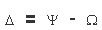
We can then write :

or :

yielding :

consolidating terms then yields :

and finally :

Let us now find the maximum value for , identified as  , by setting :

This then yields :

We then have this relation for the value of at :
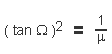
or :

Therefore, at :

Let us now bring back this equation from above :
But we have established that, at :
Therefore, at , we have :

Finally, let us recall, from above, that :
and substituting the derived values of and at , and bringing back the value of , we have :

We then present this next diagram below with { as a function of } for the reader's review :

And we shall find out next why is so important in determining whether { eigen-values } & { eigen-vectors } exists or not, in any given { linear mapping } relation.
In this case, we have the two (2) orthogonal { unit-vectors } & in { Reference Frame B } mapping onto the two (2) orthogonal vectors  &
&  in { Reference Frame A } , but in orthogonal directions other than the & directions , respectively :
as per this diagram below :

We then have the { unit-circle } in { Reference Frame B } mapping onto an { Ellipse } in { Reference Frame A } , as per this diagram below :

Again, any point { Point W } on the { unit-circle } in { Reference Frame B } then maps onto a corresponding point { Point P } on the { Ellipse } in { Reference Frame A } :
We note here that, if indeed we were able to find an { eigen-vector } for a particular { Point W } and the corresponding { Point P } , then the following condition must hold true :

in order that & are in the same direction.
Therefore, for this particular set of { Point W } & { Point P } at the { eigen-vector direction } :

But we have already set up, previously, the { lag-angle } , i.e. :
so that :
must now be equal to ,
at this particular set of { Point W } & { Point P } at the { eigen-vector direction } .
Let us now take another look at the graph for { as a function of } , as follows :

We note here that :
 } :
} :
there are four (4) points in the { 0 degrees to 360 degrees } range that satisfy the condition { = } , as marked by the 4 { red-color dots } in the above diagram ;
 } or {
  } :
} :
there are exactly two (2) points, respectively, in the { 0 degrees to 360 degrees } range that satisfy the condition { = } , as marked by the 2 { dark-green-color dots } & the 2 { light-green-color dots } respectively in the above diagram ;
 } :
} :
the condition { = } has no solution .
For our present case here where { } , we then mark-off the two (2) pairs of { eigen-vectors } in { white-color } in this diagram below :

And for the case of { } , we then mark-off the single pair of { eigen-vectors } in { white-color } in this diagram below :

And for the case of { } , we then mark-off the single pair of { eigen-vectors } in { white-color } in this diagram below :

Let us now take a look at this next five (5) diagrams in "quick-succession" with the anlge varying from { + } to { - } :

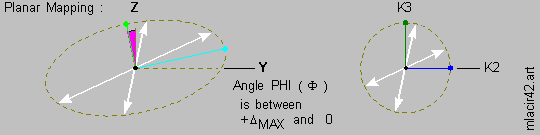


We hope we have contributed to a fairer understanding of { eigen-vectors } & { eigen values } .
Quick recap :
is controlling ,
and this in turn is dependent on the ratio , i.e. :
That is to say, that as moves towards { infinity } , moves towards { 90 degrees } , so that :
, where an { eigen-vector } can exist , is now :
{ - 90 degrees } < < { + 90 degrees } ,
i.e. the full range.
In the next Section, we shall be looking at { eigen-vectors } in 3-D Mapping.