 ,
,  , and
, and  respectively, as shown below :
We've found in { Section 2 } that, in any "non-redundant" 3-D { linear mapping } relation, a { unit-sphere } always maps onto an { ellipsoid } .
In this section, we start-off with an "upright" { unit-sphere } mapping onto an "upright" { ellipsoid } and move-back towards the original { linear mapping } relation.
This procedure then identifies / establishes the three (3) { component matrices } for the { linear mapping } relation :
And this sets the stage for our further investigation into the { Inverse } & { eigen-vectors } in subsequent sections.
Let us first set up the { Global Reference Frame } which shall remain fixed and constant throughout our analysis in this Section.
This { Global Reference Frame } is then identified by a set of three (3) orthogonal { unit-vectors } , , , and respectively, as shown below :
 &
& 
We then also set up two (2) more { reference frames }:
 ,
,  , &
, &  respectively, and
 ,
,  , &
, &  respectively,
as per this pair of diagrams below :
 &
& 
These two (2) { Reference Frames } shall also remain fixed and constant throughout our analysis in this Section, and :
, , & then maps exactly onto the { unit-vectors } , , & , respectively, in the { Global Reference Frame } ;
, , & then maps exactly onto the { unit-vectors } , , & , respectively, in the { Global Reference Frame } ;
always.
Let us now set up :
 ,
,  , &
, &  respectively, in { Reference Frame A } :
, , & respectively, initially ;
respectively, in { Reference Frame A } :
, , & respectively, initially ;
 ,
,  , &
, &  respectively, in { Reference Frame B } :
, , & respectively, initially ;
respectively, in { Reference Frame B } :
, , & respectively, initially ;
as per this pair of diagrams below :
 &
&
Let us now pick, for our analysis purposes, three (3) scalar quantities / values,  ,
,  &
&  respectively, such that :

We then set up the { linear mapping } relation between :
/ / }
and
/ / }
as follows :


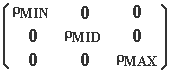

In particluar, we have the three (3) relations :


This then maps the { unit-vector } in { Reference Frame B } onto the vector  in the direction in { Reference Frame A } .


This then maps the { unit-vector } in { Reference Frame B } onto the vector  in the direction in { Reference Frame A } .


This then maps the { unit-vector } in { Reference Frame B } onto the vector  in the direction in { Reference Frame A } .
as per this pair of diagrams below :
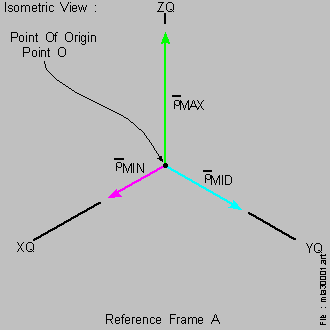 &
& 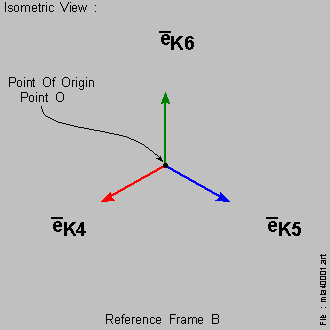
We can then identify the { axial directions } for :
/ / } in { Reference Frame B } ,
mapping onto :
/ / } in { Reference Frame A } ,
as per this pair of diagrams below :
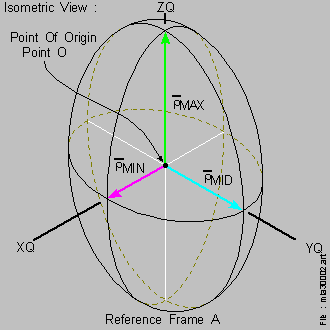 &
& 
We can then construct the { unit-sphere } and the { ellipsoid } accordingly, as per this pair of diagrams below :
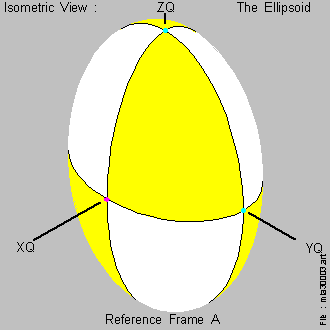 &
& 
This next pair of diagrams then shows :
 &
&
base upon / referencing the { orthogonal unit-vector basis - / / } and the { orthogonal unit-vector basis - / / } respectively.
( We will come back to this last pair of diagrams later when we discuss { eigen-vectors } in Section 6. )
Let us now identify three (3) points on the { unit-sphere } , {  } , {
} , {  } & {
} & {  } respectively :
 &
& 
such that the three (3) { unit-vectors }  ,
,  &
&  are orthogonal to one-another.
We then re-label these three (3) { unit-vectors } , & as the { unit-vectors }  ,
,  , &
, &  , respectively, as per the right-hand-side diagram above.
The { unit-vectors } , & then forms a set of { orthogonal unit-vector basis } .
Let us now set up the scalar quantities ,  ,
,  ,
,  ,
,  ,
,  ,
,  ,
,  ,
,  &
&  such that :

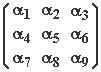

and more precisely :


The matrix  above then obeys the rules associated with a [ Unit-Basis-On-Unit-Basis Mapping Matrix } , as discussed in { Section 3 } previously.
Let us now identify three (3) points on the { ellipsoid } , namely {  } , {
} , {  } , & {
  } respectively :
 &
&
such that :
, , & : / / } in { Reference Frame B } ,
maps onto :
 ,
,  , &
, &  :
/ / } in { Reference Frame A } ,
:
/ / } in { Reference Frame A } ,
respectively.
as per this set of diagrams below :
 &
& 
We then re-label the vectors , & as the vectors  ,
,  &
&  , respectively, as per this pair of diagrams below :
 &
&
We then set up the scalar quantities  ,
,  ,
,  ,
,  ,
,  ,
,  ,
,  ,
,  &
&  such that :


yielding :


We then have the following relations :
onto :


onto :


onto :


We then consolidate the above nine (9) equations in a single { matrix equation } , as follows :
or, in an alternately format we shall use later in the Section ( the "transposed" equation ) :

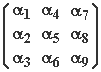
Let us now "move" / "rotate" the { axis of the Ellipsoid } and the { axis of the Unit-Sphere } via the exact-same set of motions :
 &
& 
so that the new orientations of the said { sets of axis } are now given by :
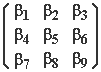

and

respectively,
as per this pair of diagrams below :
 &
& 
We note that we have "moved" / "rotated" the entire { Ellipsoid } and the entire { Unit-Sphere } so that :
} , { } , & { } are now relocated to new positions, accordingly ;
} , { } , & { } are now relocated to new positions, accordingly ;
as per the pair of diagrams below :
 &
& 
We note that the vectors , & , in { Reference Frame A } , have also been re-located, as per the left-hand-side diagram below :
 &
& 
( the right-hand-side diagram above is presented as a background reference. )
We then set up the scalar quantities  ,
,  ,
,  ,
,  ,
,  ,
,  ,
,  ,
,  , &
, &  such that :


yielding :

Instead of the vectors { , , } , we now let :
, , } in { Reference Frame B } maps onto the vectors { , , } in { Reference Frame A } .
And we set up this final { linear mapping } relation with :
in { Reference Frame B } mapping onto the vector in { Reference Frame A } ,
in { Reference Frame B } mapping onto the vector in { Reference Frame A } ,
in { Reference Frame B } mapping onto the vector in { Reference Frame A } ;
as per this pair of diagrams below :
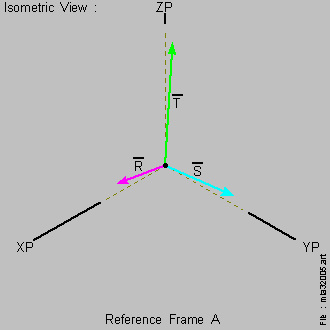 &
& 
This final { linear mapping } relation is then :


Let us now look more closely at this final { linear mapping } relation by bringing back several equations from above :
and,
Combining these three (3) equations then yields :
We then compare this to an another equation from { Topic VII } immediately above, i.e. :
to arrive at :
Transposing the entire equation then yields :
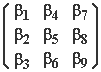
This then is the most important equation, central to the concepts presented here in this Section.
Via this latest equation above, we have effectively broken-down the final { linear mapping } relation, i.e. :
into three (3) parts :
 ,
, and its [ Transpose ]
,
, and its [ Transpose ]  ,
,
 , and its [ Transpose ]
  .
.
To assist the reader to carry-thru this concept / system onto multi-dimensions, we provide herewith this table below :
| Description of Vector-Space |
Degrees Of Freedoms ( DOF's ) associated with |
Total DOF's |
||
|---|---|---|---|---|
| { Matrix RHO } ( Ellipsoid ) |
{ Matrix ALPHA } & ( Local Orientation ) |
{ Matrix BETA } & ( Rotation ) |
||
| 3-Dimensional Vector-Space | 3 | 3 | 3 | 9 |
| 4-Dimensional Vector-Space | 4 | 6 | 6 | 16 |
| 5-Dimensional Vector-Space | 5 | 10 | 10 | 25 |
| 6-Dimensional Vector-Space | 6 | 15 | 15 | 36 |
| 7-Dimensional Vector-Space | 7 | 21 | 21 | 49 |
The advantages for the concept / system presented here will be fully demonstrated in the next Section on the [ Inverse ] , and in subsequent Sections on [ eigen-vectors ] & [ eigen-values ] .