

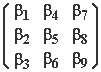
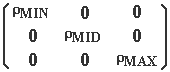
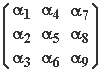
| Topic I | Introduction & Summary for this Section |
| Topic II | Defining the { Inverse } |
| Topic III | Setting up the { Matrix CHI } |
| Topic IV | Finding the [ Inverse ] |
| Topic V | The "Heart Transplant" |
| Topic VI | The Shape of the { Ellipsoid } |
This Section is a continuation of { Section 4 } and we shall attempt to find the [ Inverse ] for the matrix :
In the last topic, we break the [ Inverse ] process into a [ Heart-Transplant ] operation and a [ Transpose ] operation, for further thoughts.
If we have a { Matrix R-S-T } and a { Matrix A-B-C } such that :


then, the { Matrix A-B-C } is the [ Inverse ] of the { Matrix R-S-T } .
Let us now set up three ( 3 ) scalar quantities / values,  ,
,  , &
, &  respectively, such that :
= { 1 /  } ,
= { 1 /
} ,
= { 1 /  } , and
= { 1 /
} , and
= { 1 /  } .
} .
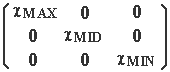
We then set up the { Matrix CHI } as follows :
 =
= 
We note here immediately that :
and
so that the { Matrix RHO } and the { Matrix CHI } are the [ Inverse ] of one-another.
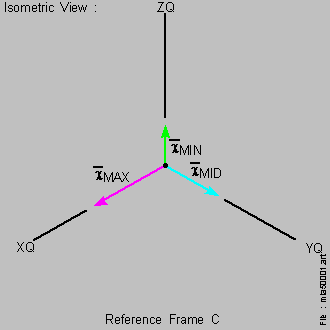
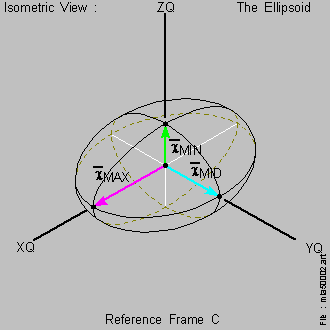
We then present this next three (3) sets of diagrams for comparison purposes, with :
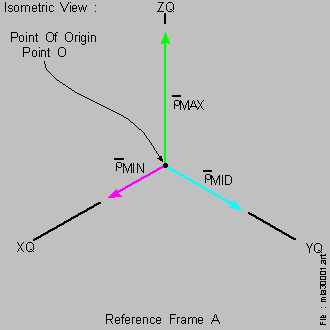 &
& 
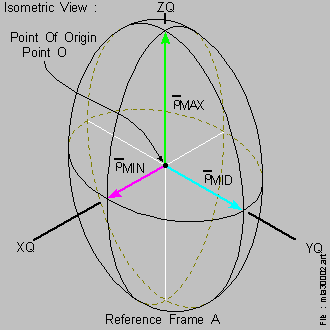 &
& 
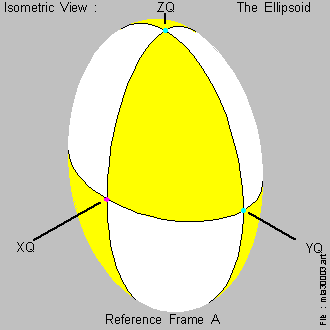 &
& 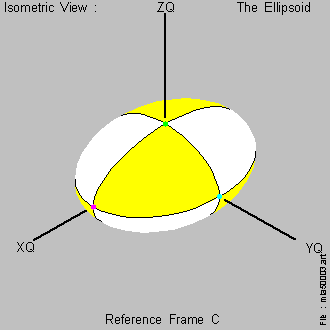
for the reader's review and setting the stage for our discussion in the next [ topic ] below.
We then present this equation in our quest to find the [ Inverse ] :
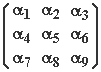
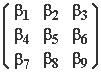
or, in the alternate "concise" format :


arising from :
where is the [ Identity Matrix ] .
Based on this "long" equation above, we can then conclude that, for the { Matrix R-S-T } given by :
the [ Inverse ] , i.e. the { Matrix A-B-C } , is given by :
A rather simple derivation , "chopping" the "long" equation in halves.
We also note here that :
or, in an alternate "concise" format :
so that :
Thus, { Matrix R-S-T } is the [ Inverse ] of { Matrix A-B-C } .
The next question is based on this comparison for the [ SELF ] matrix , i.e. { Matrix R-S-T } , and the [ INVERSE ] matrix , i.e. { Matrix A-B-C } :
| Composition Matrices | |||
|---|---|---|---|
| the Rotation Matrix |
the Characteristic Matrix for the Ellipsoid |
the Local Orientation Matrix |
|
| [ SELF ] | |
|
|
| [ INVERSE ] | |
|
|
The intriguing question is why, for the [ INVERSE ] ,
has now become the { Local Orientation Matrix } , and
has now become the { Rotation Matrix } ?
A starting point here could possibly be the observation that :
, and consequently ,
can & receive the "same" treatment.
Reader's comments here ?
We bring in here a concept arising from the author's study of the { I-Ching } :
But let us first set up two (2) more matrices, in addition to the [ SELF ] & the [ INVERSE ] :
[ T-O-S ] =
[ T-O-I ] =
We then put all four (4) matrices in the { 4-Quadrant Diagram } below :
| [ SELF ] |
[ T-O-S ] |
|---|---|
| [ T-O-I ] |
[ INVERSE ] |
The observation on this { 4-Quadrant Diagram } here is simply this :
exchanging the { Matrix RHO } for the { Matrix CHI } , or visa-versa ;
The [ Inverse ] is then the result of two (2) operations :
in any order / either order .
And in the { Heart Transplant } operation, each { non-zero diagonal-element } of the { Matrix RHO } is replaced with its reciprocal to form the { Matrix CHI } .
We note here that :
/ } is always equal to the ratio { / } , so that :
's & 's are "reciprocating", both in value and in rank.
Let us now illustrate this point with the two (2) numerical examples below :
| value of |
value of |
value of |
ratio of / |
ratio of / |
ratio of / |
|
|---|---|---|---|---|---|---|
| [ Matrix RHO ] | 1.800 | 1.200 | 0.900 | 2.000 | 1.500 | 1.333 |
| [ Matrix CHI ] | 1.111 | 0.833 | 0.556 | 2.000 | 1.333 | 1.500 |
| value of |
value of |
value of |
ratio of / |
ratio of / |
ratio of / |
| value of |
value of |
value of |
ratio of / |
ratio of / |
ratio of / |
|
|---|---|---|---|---|---|---|
| [ Matrix RHO ] | 1.800 | 1.273 | 0.900 | 2.000 | 1.414 | 1.414 |
| [ Matrix CHI ] | 1.111 | 0.786 | 0.556 | 2.000 | 1.414 | 1.414 |
| value of |
value of |
value of |
ratio of / |
ratio of / |
ratio of / |
We note here that :
/ } & { / } are matched exactly.
We now make these two (2) statements for the reader's further thoughts :
If the { diagonal-elements } of a 7 x 7 { Matrix RHO } is an { ascending geometric series } , then :
so that the shapes of the { RHO-ellipsoid } & the { CHI-ellipsoid } are the same.
If the following condition for a 7 x 7 { Matrix RHO } is matched :

then the { RHO-ellipsoid } & the { CHI-ellipsoid } have the exact-same shape.
( the ratios are matched axis-for-axis in both cases. )
We move-on next to { eigen-vectors } & { eigen-values } , which will further demonstrate the importance of this { / } ratio.