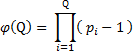
We then set up , for the [ Modulo M Prime Number System ] , the following :
- the value [ T-sub-Q ] :
- the set [ Set Tau ] :

or


for easier-notation purposes .
Thus , for the expansion from [ Modulo 30 ] to [ Modulo 210 ] , we can simply :
and
| Column1 | Column2 | Column3 | Column4 | Column5 | Column6 | Column7 | Column8 | |
|---|---|---|---|---|---|---|---|---|
| ******** | ******** | ******** | ******** | ******** | ******** | ******** | ******** | ******** |
| Row 1 | 1 | 7 | 11 | 13 | 17 | 19 | 23 | 29 |
| Row 2 | 31 | 37 | 41 | 43 | 47 | 49 | 53 | 59 |
| Row 3 | 61 | 67 | 71 | 73 | 77 | 79 | 83 | 89 |
| Row 4 | 91 | 97 | 101 | 103 | 107 | 109 | 113 | 119 |
| Row 5 | 121 | 127 | 131 | 133 | 137 | 139 | 143 | 149 |
| Row 6 | 151 | 157 | 161 | 163 | 167 | 169 | 173 | 179 |
| Row 7 | 181 | 187 | 191 | 193 | 197 | 199 | 203 | 209 |
to arrive at the 48 { Candidates-for-Primes } for the [ Modulo 210 Prime Number System ] .
We then set up , for the [ Modulo M Prime Number System ] , the following :

or
for easier-notation purposes .
as the core sample-element for our demonstration of the Expansion Process .
We then label the selected sample-element as [ Tau-sub-FIXED ] :

We then have the following [ New Possibilites ] for the { candidate-for-primes } for the [ new modulo ] :





And in general , the expansion formula here is :

To answer this question , let us now set up the { gamma-sub-[ i ] }'s given by :

or


and

And we take special notice here that [ K2 ] is never [ zero ] because :
and substitute therein the values [ K1 ] and [ K2 ] to arrive at this equation :

And since the value of [ i ] runs from [ 1 ] to [ E ] but never exceeds [ E ] ,

based on the equation immediately above .
This then lead us necessarily to conclude that :
and
And that-is-to-say :


This then leads us to conclude that :
and

And that-is-to-say :
multiplied by :
with the value of [ E ] here being the value of the prime-number taking responsibility
The Statement :
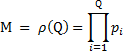
the number of { candidates-for-primes } for that particular [ modulo M ] is given by :