- the function { PSI-sub-beta-of-(x) } for the [ Modulo M Prime Number System ] ,
where :
- the value of [ M ] is the { product-of-primes for the first-[ Q ] prime-numbers } .
And the function { PSI-sub-beta-of-(x) } shall take on this format :
where :
And the function { PSI-sub-beta-of-(x) } shall take on this format :
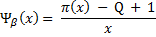
so that :
We then have :

or :

We then set up the the function { rho-of-(Q) } ,
And we have :

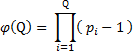
for our use in the Sections to follow .
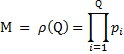
And we take note here again of this characteristic for the [ Modulo M Prime Number System ] ,

In other word ,
and also :
within the context of the [ Modulo M Prime Number System ] .

to identify these prime-numbers that have been excluded .
for our [ Modulo M Prime Number System ] based on [ Q ] .
And we note here that :
As such , counting consistency is maintained throughout within the context of the [ Modulo M Prime Number System ] .
as the product of 2 ratios .
We then set up the ratios [ R1 ] and [ R2 ] as follows :

and

Consequently , we can now write :
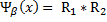
This is because :
can never exceed the number of { candidates-for-prime } for the same [ Modulo M Prime Number System ] .
This is because :
is always less the full field of natural numbers from [ 1 ] to [ x ] .