

In this Section , we look at { Triangles with Interger Sides } ,
Let us now take a quick look at the { cosine-square } & { sine-square } functions :
 } over this range , and that is to say :
then { X } is greater than { Y } .
But more on this later in the last [ Topic ] of this Section .
Let us now bring in this { trigonometric identity } :

We may now take the view that each value of { } simply identifies a unique & particular way / manner :
over the range of { 0 to 90 degrees } .
Let us now bring back this formula for the [ Area-of-the-Triangle ] , { A-O-T } , from [ Section II - Topic #4 ] :


And because [ area = one-half * base * height ] , we can express :
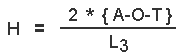
We then have :

yielding :

And { Cosine-Square } may be found via :

Thus , as we have previously stated in [ Section II ] :
the values of { Sine-Square } & { Cosine-Square } are always { whole-fractions } for all of the { 3 angles } .
And we shall look at this next .
Let us now take a quick look at 3 examples of [ Triangles with { Integer Sides } ] :
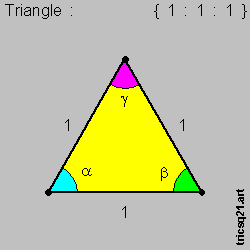
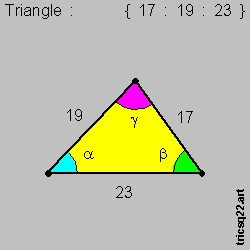
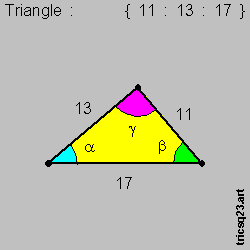
And we summarize the calculations as follows :
| L1 | L2 | L3 | 16 * A-O-T |
sin^2  |
sin^2  |
sin^2  |
cos^2 |
cos^2 |
cos^2 |
|---|---|---|---|---|---|---|---|---|---|
| 1 | 1 | 1 | 3 | 3 / 4 | 3 / 4 | 3 / 4 | 1 / 4 | 1 / 4 | 1 / 4 |
| 17 | 19 | 23 | 402,675 | 402,675 / 763,876 | 402,675 / 611,524 | 402,675 / 417,316 | 361,201 / 763,876 | 208,849 / 611,524 | 14,641 / 417,316 |
| 11 | 13 | 17 | 81,795 | 81,795 / 195,384 | 81,795 / 139,876 | 81,795 / 81,796 | 133,589 / 195,384 | 58,081 / 139,876 | 1 / 81,796 |
Let us now pick the { 17 : 19 : 23 } Triangle , ( i.e. the diagram in-the-middle ) , and ask this question :
] is [ 402,675 / 763,876 ] ?
But before we answer that , let us take a quick look at merging [ Right-Angle Triangles with { Integer Sides } ] , next .
Let us now attempt to merge 2 { Right-Angle Triangles with Integer Sides } , the { 5-12-13 Triangle } & the { 3-4-5 Triangle } :


And we have the { merged triangle } as per the the diagram on-the-right , above .
We then have this table below for the value of [ Sine-Square ] , for the diagrams on-the-left & on-the-right , above :
| L1 | L2 | L3 | 16 * A-O-T |
sin^2 |
cos^2 |
|---|---|---|---|---|---|
| 5 | 12 | 13 | 14,400 | 14,400 / 97,344 | 82,944 / 97,344 |
| 25 | 52 | 63 | 6,350,400 | 6,350,400 / 42,928,704 | 36,578,304 / 42,928,704 |
As expected , both fractions : [ 14,400 / 97,344 ] & [ 6,350,400 / 42,928,704 ] , reduce to [ 25 / 169 ] .
This then proves that the same value of [ Sine-Square ] can arise from more-than-one [ Triangles with { Integer Sides } ] .
Let us suppose , for the time being , that we are restricted to using only { positive integers less than [ 16 ] } for our [ Triangles with { Integer Sides } ] .
} being differently sized , and
} also being different .
And we can then rank these [ Triangles with { Integer Sides } ] in accordance to the associated values of { Sine-Square } , in an ascending-order .
} are also ranked in an ascending order .
Let us now draw two (2) random lines on a piece of paper that do not intersect at { right-angles } ,
} .
We can then do a physical comparison with our { ranked series } created above and identify two (2) adjacent sizes of { } , i.e. :
 } & {
} & {  } respectively ,
such that :

And we have the corresponding relation :

We have therefore developed a system of closing-in on the size of { angle } .
And , if we needed more accuracy , we can always relax our first restriction above by :
to close-in on the gap between { } & { } .
Our open question here is this :
Does this have anything to do with anything at all ??? ( Again , reader's call ) .