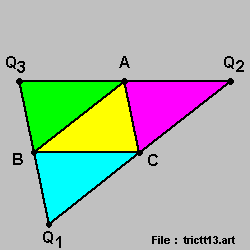
We start-off with any triangle , { Triangle Q1-Q2-Q3 } , and :
- we identify the mid-points as { Point A } , { Point B } , & { Point C } , respectively ,
- we then join the mid-points to produce 4 { congruent triangles } , as shown in the diagram on-the-left ,
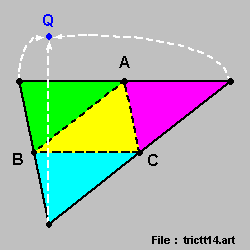
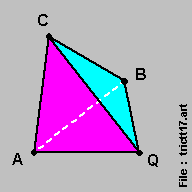
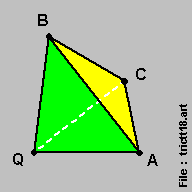
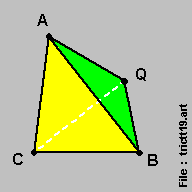
- we then fold the 3 corners upwards , creasing along the black dotted-lines as marked in the diagram in-the-middle ,
- to meet at a single point , { Point Q } ,
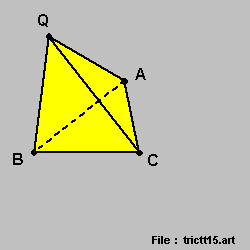
- and we end up with the { C-T Tetrahedron } as shown in the diagram on-the-right .
( note : the { Right-Angle Triangle } is a special case . )
- if we were to toss the { C-T Tetrahedron } and let it land on a table-top / horizontal-surface ,
then , no matter which of the 4 surfaces it lands on :
- the { shape & size } of the contact-surface will always be the same ,
- the { shape & size } of the { landed-object } will always { look-the-same } .
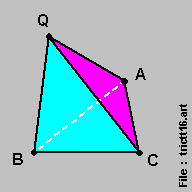
- one single & unique point , within the { C-T Tetrahedron } , serves as :
- the { center-point } for the { circumscribing sphere } passing thru the 4 nodal-points ,
- the { center-point } for the { inscribing sphere } just-touching the 4 surfaces , &
- the { centroid } for the { C-T Tetrahedron } ,
- the { Fermat Point } , where the { sum of the distances to the 4 nodal-points } is { at-a-minimum } .
Rather interesting !