
| Topic #1 | Introduction & Summary for the Section |
| Topic #2 | { Equilateral / Isosceles / Unequal-sides Triangles } |
| Topic #3 | Setting up a { Triangle } in general |
| Topic #4 | Mid-Points & the { Centroid } |
| Topic #5 | The { Equi-distant Point } |
| Topic #6 | The { Angle Bisectors } |
| Topic #7 | Perpendicular Lines to the Opposite Sides |
| Topic #8 | The { Fermat Point } |
In this Section , we shall be looking at Triangles in general .
In particular , we shall identify special { points } associated with the { Triangle } , and briefly describe their properties .
This then lays the foundation framework for { Section IV } , when move-on to the { Congruent-Triangles Tetrahedron } .
In general , we can identify three (3) types of { triangles } :
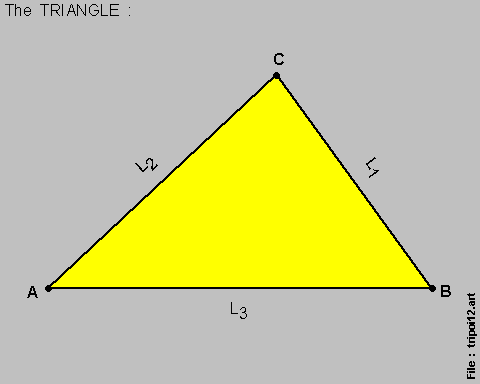
Let us first set up , in general , a triangle --- { Triangle A-B-C } :
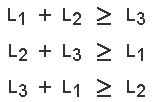
The following { inequalities } then always hold true , for any Triangle :
Let us now identify the { mid-points } of the 3 sides as { Point D } , { Point E } , & { Point F } respectively , as per this diagram below :
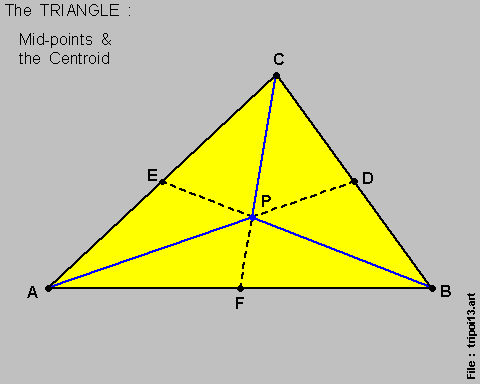
The lines { Line A-D } , { Line B-E } , & { Line C-F } do intersect at a single point , { Point P } as identified above , and this is the { Centroid } of the { Triangle } .
The significance of the { Centroid } is that :
then the { Center-of-Mass } would be at the { Centroid } of the { Triangle } , or { Point P } .
There is always a point that is { equi-distant } from the 3 vertices , as identified by { Point P } in this diagram below :
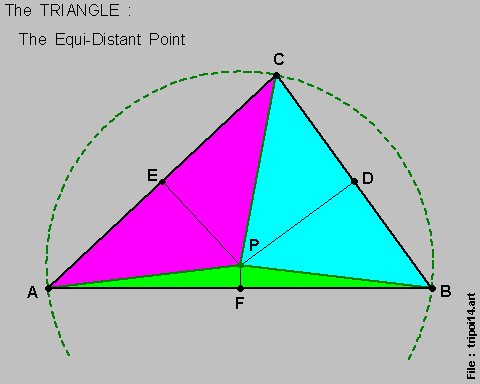
And this point is usually identified via the following procedure :
We also note here , in passing , that :
Let us now construct 3 { lines } bisecting the 3 { angles } of the { Triangle } , as per this diagram below :
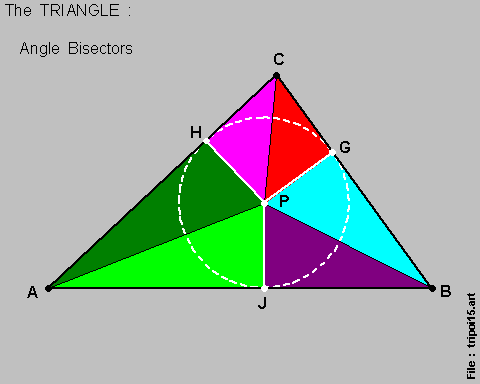
And these 3 { lines } do intersect at a single point , { Point P } as shown above .
Let us now 'drop' , from { Point P } , perpendicular lines to the 3 { sides } so that :
Noting that { Line A-P } , { Line B-P } & { Line C-P } are { angle bisectors } , it immediately follows that :
so that { Line P-G } , { Line P-H } & { Line P-J } are { of-equal-lengths } .
As such , { Point P } is then the { center } for the { Inscribing Circle } , as marked above .
Let us now 'drop' , from each of the 3 vertices , perpendicular lines to the { Opposite Sides } :

so that :
These 3 { lines } do intersect at a single point , { Point P } , as marked in the diagram above .
The significance of this { point } shall be discussed later in { Section IV } , when we move-on to the { Congruent-Triangles Tetrahedron } .
The { Fermat Point } is the point where the { sum of the distances to the 3 vertices } is { at-a-minimum } .
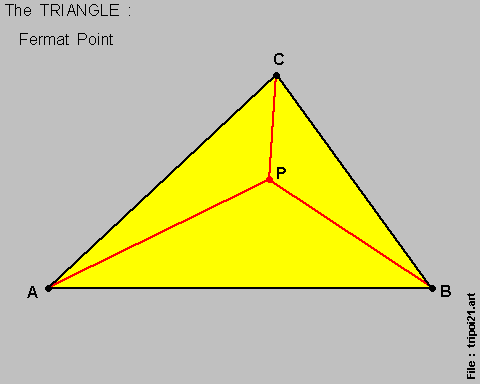
We shall simply mention here a special property for the { Fermat Point } , as identified by { Point P } in the above diagram :
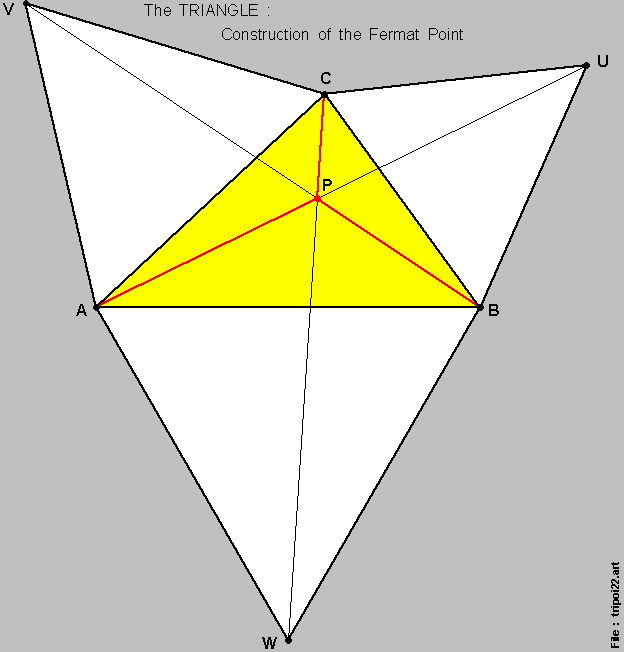
The { Fermat Point } is usually identified via the following procedure :
and we identify the { outer-vertex } for each of the 3 { equilaterial triangles } as { Point U } , { Point V } , & { Point W } respectively ,
as per this diagram below :
We shall have a more detailed discussion on this in Section VI --- An Infinite Series of { Triangles } .