
In the [ ICG Approach ] , we make use of a conventional { 3-Dimensional Vector Space } , with the three (3) [ orthogonal / perpendicular ] axis being :
We then seperate { Global Space / Universal Space } into eight (8) sections, via the introduction of :
We then place a different and unique Trigram into each of eight (8) [ EIGHTH's ] thus created :

The [ Trigram Placement Scheme ] here is then based on :
as per the diagram below :

And the placements are done in accordance with :
And we shall take :
 , as representing the [ 'positive' ] , and
 , as representing the [ 'negative' ] .
And a different Trigram is placed into each of the eight (8) [ EIGHTH's ] in accordance to :
| Is 'X' 'positive' or 'negative' ? |
Is 'Y' 'positive' or 'negative' ? |
Is 'Z' 'positive' or 'negative' ? |
|||
|---|---|---|---|---|---|
| T1 |  |
- heaven | 'X' is positive | 'Y' is positive | 'Z' is positive |
| T2 |  |
- lake | 'X' is positive | 'Y' is positive | 'Z' is negative |
| T3 |  |
- fire | 'X' is positive | 'Y' is negative | 'Z' is positive |
| T4 |  |
- thunder | 'X' is positive | 'Y' is negative | 'Z' is negative |
| T5 |  |
- wind | 'X' is negative | 'Y' is positive | 'Z' is positive |
| T6 |  |
- water | 'X' is negative | 'Y' is positive | 'Z' is negative |
| T7 |  |
- mountain | 'X' is negative | 'Y' is negative | 'Z' is positive |
| T8 |  |
- earth | 'X' is negative | 'Y' is negative | 'Z' is negative |
Thus, the Trigram 'heaven' , , is placed in the { EIGHTH } where :
And so-on-and-so-forth.
We note here that we can also view this [ Trigram Placement Scheme ] as placing the eight (8) Trigrams at the eight (8) corners of a cube, as per the diagram below :

This is an important diagram, basic to the [ ICG Approach ].
And we shall be :
The [ ICG Hexagram Placement Scheme ] is based on :
in accordance to the rules listed below in the next Topic - the { Technical Specifications } .
( an [ Integer Grid Point ] is a point in the { 3-Dimensional Vector Space } whose co-ordinates { X, Y, Z } has :
The 'basics' of the { ICG Hexagram Placement Scheme } , firstly, involves a re-labelling of the [ 6 Lines ] of the Hexagram :
as per the diagram below :
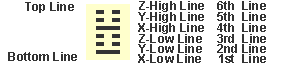
And secondly, in very general terms , it involves :
But continuity is achieved, always, because every { Hexagram } at every { integer-grid-point } obeys the following :
Let us now move onto the next Topic, the { Technical Specifications }.
Let us now construct the unique Hexagram at any specific [ Integer Grid Point ] location in accordance to the following rules :
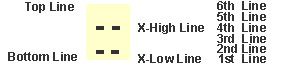


( Link to Section 7 - Topic 2 for a brief description of { modulo Mathematics } )


These then are the { Technical Specifications } for the { ICG Hexagram Placement Scheme } .
Let us now look briefly at the results arising from these 'construction rules' :
For the [ Y-Z plane ] at { X = 0 }, we have the diagrams below :


For the [ Y-Z plane ] at { X = 1 }, we have the diagrams below :
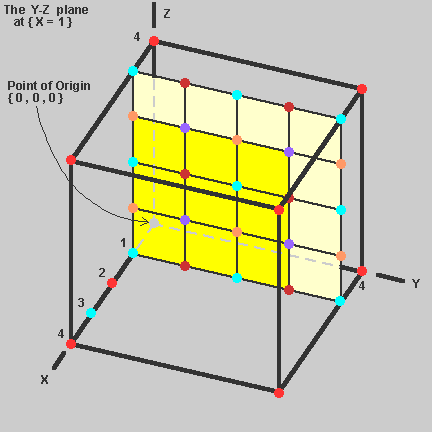

For the [ Y-Z plane ] at { X = 2 }, we have the diagrams below :


For the [ Y-Z plane ] at { X = 3 }, we have the diagrams below :


We note here that :
We have therefore constructed a continuous { 'sea' of Hexagrams } , continuous 'ad-infinitum', in the 'X-direction', in the 'Y-direction', and in the 'Z-direction'.
The power and strength of the { ICG Hexagram Placement Scheme } lies in its [ continuity ] :
This facilitates a [ better / easier ] visualization of the [ path/s ] of the [ Life Situations ] that the [ SELF ] may wish to go thru, as well as the [ options ] , the [ consequences ] and the [ reactions ] they may bring about.
It is like { visualizing } the state of a Chess Game, { 10 or 15 moves onwards } .
Let us now look at the position of :
i.e.
 vs.
vs.  , or [ T1-T1 ] vs. [ T8-T8 ] .
The position of :
as per the diagram below :

An appropriate caption for this diagram is then :

And the { directions } pointing from the [ Hexagram 'heaven' ] towards the 8 [ Hexagrams 'earth' ] are then :
| { | +1, | +1, | +1 | } | , | { | +1, | +1, | -1 | } | , | { | +1, | -1, | +1 | } | , | { | +1, | -1, | -1 | } | , |
| { | -1, | +1, | +1 | } | , | { | -1, | +1, | -1 | } | , | { | -1, | -1, | +1 | } | , | { | -1, | -1, | -1 | } | . |
all { 'cross-diagonal' directions } .
Based on the above, we then have the following for the reader's further thoughts :

| { |  | within |  | } | and | { | | within | | } |

Let us now look at these two (2) diagrams below :


The [ diagram on-the-left ] is the { Trigram Positioning according to FU XI } and the [ diagram on-the-right ] is the { ICG 'CUBE' } .
In both diagrams, we have :
Both diagrams indicate that each of the above 4 { pairs of Trigrams } remain at 'opposite' positions.
Let us now look at these two (2) diagrams below :


The [ diagram on-the-left ] is the { Trigram Positioning according to WEN WANG } and the [ diagram on-the-right ] is the { ICG 'CUBE' } .
In both diagrams, we have :
And in the [ diagram on-the-right ], i.e. the { ICG 'CUBE' } diagram :
The message from the { Trigram Positioning according to WEN WANG } is clear and simple :
Let us now move on for more details on the { 'cross-diagonal' direction/s } in the next Topic below.
Let us now look at this diagram below, which demonstrates the [ PARITY of '4' ] :

The four (4) { white-color lines } are then the { 'cross-diagonals' } joining the 'opposite' corners of the { 'cube' } .
And these four (4) { white-color lines } are [ on par ] with one-another :
We have therefore achieved :
And reference is made here, again, to the { Trigram Positioning according to WEN WANG } diagram in Topic IX above, on the importance of the { cross-diagonal directions } .
In the 'I-CHING' , the number [ 4 ] came up on several occasions :
The geometric [ PARITY of '4' ] , presented above, then permits { CHANGES } in the { 4 dimensions } to be looked at on 'equal footings' .
And on other fronts:
Again a { modulo 4 } based concept.
More on this later in Section 7 , when we look at { 4-Quadrant Diagrams } .