 R modulo P
( read : [ X ] is congruent to [ R ] modulo [ P ] )
| Topic I | Introduction & Brief Summary for the Section |
| Topic II | Modulo Mathematics Basics |
| Topic III | The { Additive Conjugate } & the { Multiplicative Conjugate } |
| Topic IV | An example for { Modulo 13 } |
| Topic V | Define the quantity [ M-O-A ] |
| Topic VI | The { Reverse } & the { Opposite } in Hexagrams |
| Topic VII | The Listing Order of the 64 Hexagrams |
| Topic VIII | Re-grouping the 64 Hexagrams |
| Topic IX | Observing the similarities |
| Topic X | An Analysis of the { Reverse } Process |
| Topic XI | The 'Flipping' Rules |
| Topic XII | { Non-Parity } in the 'I-CHING' |
In this section, we shall be comparing the [ Parity of '4' ] :
By the end of the Section, we would have moved onto { Non-Parity } in the 'I-CHING' arising from the { Reverse } process.
In general, if [ P ] is a { positive integer } and [ X ] is a { positive integer }, then the statement :
R modulo P
( read : [ X ] is congruent to [ R ] modulo [ P ] )
is the same as :
And [ R ] can be viewed as the { remaider } when [ X ] is divided by [ P ] .
We then define the { Additive Conjugate } and the { Multiplicative Conjugate } as follows :
X + Y 0 modulo P
X * Z 1 modulo P
( [ Z ] always exists if [ P ] is a { prime number } ) .
We then have an example here for { modulo 13 } :
0 modulo 13
so that [ 10 ] is the { Additive Conjugate } of [ 3 ] { modulo 13 } .
1 modulo 13
so that [ 9 ] is the { Multiplicative Conjugate } of [ 3 ] { modulo 13 } .
We now also define the quantity [ M-O-A ] as the [ { Multiplciative Conjugate } of the { Additive Conjugate } , { modulo P } ] .
And [ 4 ] is then the [ M-O-A ] of [ 3 ] { modulo 13 } , arising from :
0 modulo 13 , ( [ 10 ] is the { Additive Conjugate } of [ 3 ] ) , and
1 modulo 13 , ( [ 4 ] is the { Multiplicative Conjugate } of [ 10 ] ) .
We note here, without further proof, that :
is the same as
i.e. :
1 modulo 13 , ( [ 9 ] is the { Multiplicative Conjugate } of [ 3 ] ) , and
0 modulo 13 , ( [ 4 ] is the { Additive Conjugate } of [ 9 ] ) .
And we arrive here at [ 4 ] being :
same as the [ { Multiplicative Conjugate } of the { Additive Conjugate } ] we have originally above.
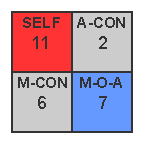
We can then re-group the 12 digits { from [ 1 ] to [ 12 ] } for { modulo 13 } into four (4) groups :


( [ A-CON ] is the { Additive Conjugate } & [ M-CON ] is the { Multiplicative Conjugate } ).



The [ Reverse ] for any given Hexagram simply is the Hexagram { read-upside-down }, i.e. :
The [ Opposite ] for any given Hexagram is simply changing each of the { 6 Lines } of the Hexagram to the 'Opposite Line' .
And we also define the [ O-O-R ] Hexagram as the { [ Opposite ] of the [ Reverse ] } of any given Hexagram.
And it would be best to give an example here :
| Origial Hexagram |
Reverse Hexagram |
Opposite Hexagram |
O-O-R Hexagram |
|---|---|---|---|
  |
  |
  |
  |
And the { 4-quadrant diagram } here is :

We then have a listing of the 1st thirty (30) Hexagrams, in the order as they appear in the [ First Section ] (  ) of the 'I-CHING' :
| Pair Name |
Order / Rank |
1st member | 2nd member | Comments | |||
|---|---|---|---|---|---|---|---|
| Pair 1 | 1, 2 |  |
 |
 |
 |
{ T1-T1 } & { T8-T8 } | |
| Pair 2 | 3, 4 | |
|
|
|
{ T6-T4 } & { T7-T6 } | |
| Pair 3 | 5, 6 |  |
 |
 |
 |
{ T6-T1 } & { T1-T6 } | |
| Pair 4 | 7, 8 |  |
 |
 |
 |
{ T8-T6 } & { T6-T8 } | |
| Pair 5 | 9, 10 |  |
 |
 |
 |
{ T5-T1 } & { T1-T2 } | |
| Pair 6 | 11, 12 |  |
 |
 |
 |
{ T8-T1 } & { T1-T8 } | |
| Pair 7 | 13, 14 |  |
 |
 |
 |
{ T1-T3 } & { T3-T1 } | |
| Pair 8 | 15, 16 |  |
 |
 |
 |
{ T8-T7 } & { T4-T8 } | |
| Pair 9 | 17, 18 |  |
 |
 |
 |
{ T2-T4 } & { T7-T5 } | |
| Pair 10 | 19, 20 |  |
 |
 |
 |
{ T8-T2 } & { T5-T8 } | |
| Pair 11 | 21, 22 |  |
 |
 |
 |
{ T3-T4 } & { T7-T3 } | |
| Pair 12 | 23, 24 |  |
 |
 |
 |
{ T7-T8 } & { T8-T4 } | |
| Pair 13 | 25, 26 |  |
 |
 |
 |
{ T1-T4 } & { T7-T1 } | |
| Pair 14 | 27, 28 |  |
 |
 |
 |
{ T7-T4 } & { T2-T5 } | |
| Pair 15 | 29, 30 |  |
 |
 |
 |
{ T6-T6 } & { T3-T3 } | |
 ) of the 'I-CHING' :
| Pair Name |
Order / Rank |
1st member | 2nd member | Comments | |||
|---|---|---|---|---|---|---|---|
| Pair 16 | 31, 32 |  |
 |
 |
 |
{ T2-T7 } & { T4-T5 } | |
| Pair 17 | 33, 34 |  |
 |
 |
 |
{ T1-T7 } & { T4-T1 } | |
| Pair 18 | 35, 36 |  |
 |
 |
 |
{ T3-T8 } & { T8-T3 } | |
| Pair 19 | 37, 38 |  |
 |
 |
 |
{ T5-T3 } & { T3-T2 } | |
| Pair 20 | 39, 40 |  |
 |
 |
 |
{ T6-T7 } & { T4-T6 } | |
| Pair 21 | 41, 42 |  |
 |
 |
 |
{ T7-T2 } & { T5-T4 } | |
| Pair 22 | 43, 44 |  |
 |
 |
 |
{ T2-T1 } & { T1-T5 } | |
| Pair 23 | 45, 46 |  |
 |
 |
 |
{ T2-T8 } & { T8-T5 } | |
| Pair 24 | 47, 48 |  |
 |
 |
 |
{ T2-T6 } & { T6-T5 } | |
| Pair 25 | 49, 50 | |
|
|
|
{ T2-T3 } & { T3-T5 } | |
| Pair 26 | 51, 52 |  |
 |
 |
 |
{ T4-T4 } & { T7-T7 } | |
| Pair 27 | 53, 54 |  |
 |
 |
 |
{ T5-T7 } & { T4-T2 } | |
| Pair 28 | 55, 56 |  |
 |
 |
 |
{ T4-T3 } & { T3-T7 } | |
| Pair 29 | 57, 58 |  |
 |
 |
 |
{ T5-T5 } & { T2-T2 } | |
| Pair 30 | 59, 60 |  |
 |
 |
 |
{ T5-T6 } & { T6-T2 } | |
| Pair 31 | 61, 62 |  |
 |
 |
 |
{ T5-T2 } & { T4-T7 } | |
| Pair 32 | 63, 64 |  |
 |
 |
 |
{ T6-T3 } & { T3-T6 } | |
We take note here that, in this Listing Order , the { 2nd member } of each pair of Hexagrams is :
either :or :
And this happened for { Pair 1 } , { Pair 14 } , { Pair 15 } , & { Pair 31 } , respectively.
And this is the strongest confirmation that the { 'Reverse' } and the { 'Opposite' } are very much an integral part of the 'I-CHING' .
We can then re-group the 64 Hexagrams into three (3) groups :
| Name of Sub-group |
Origial Hexagram |
Reverse Hexagram |
Opposite Hexagram |
O-O-R Hexagram |
Comments |
|---|---|---|---|---|---|
| SYM-1 | |
|
|
|
Pair 1 |
| SYM-2 | |
|
|
|
Pair 14 |
| SYM-3 | |
|
|
|
Pair 15 |
| SYM-4 | |
|
|
|
Pair 31 |
These 8 members of this group are then characterized by :
And the format of the { 4-quadrant diagram } here is :

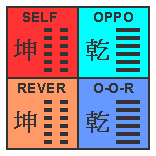
| Name of Sub-group |
Origial Hexagram |
Reverse Hexagram |
Opposite Hexagram |
O-O-R Hexagram |
Comments |
|---|---|---|---|---|---|
| OPP-1 | |
|
|
|
Pair 6 |
| OPP-2 | |
|
|
|
Pair 32 |
These 4 members of the group are then characterized by :
And the format of the { 4-quadrant diagram } here is :


| Name of Sub-group |
Origial Hexagram |
Reverse Hexagram |
Opposite Hexagram |
O-O-R Hexagram |
Comments |
|---|---|---|---|---|---|
| ORD-1 | |
|
|
|
Pair 2 & Pair 25 |
| ORD-2 | |
|
|
|
Pair 3 & Pair 18 |
| ORD-3 | |
|
|
|
Pair 4 & Pair 7 |
| ORD-4 | |
|
|
|
Pair 5 & Pair 8 |
| ORD-5 | |
|
|
|
Pair 10 & Pair 17 |
| ORD-6 | |
|
|
|
Pair 11 & Pair 24 |
| ORD-7 | |
|
|
|
Pair 12 & pair 22 |
| ORD-8 | |
|
|
|
Pair 13 & Pair 23 |
| ORD-9 | |
|
|
|
Pair 16 & Pair 21 |
| ORD-10 | |
|
|
|
Pair 19 & Pair 20 |
| ORD-11 | |
|
|
|
Pair 26 & Pair 29 |
| ORD-12 | |
|
|
|
Pair 28 & Pair 30 |
These 48 members of the group are then characterized by :
And the format of the { 4-quadrant diagram } here is :


We now make an observation that :
, , and
and
, , and
are rather similar.
We simply note here that the { 4-quadrant diagrams } are also used as an analysis tool in the author's other paper, "An Approach to Matrix & Linear Algebra" .
The { Parity-of-'4' } is clearly a very interestsing subject requiring further studies.
We shall now look more closely at the { Reverse } process, using the { ICG Hexagram Placement Scheme } from Section 5 as a guideline for our analysis.
Let us now break-up the six (6) Lines of the Hexagram into two (2) groups :
We simply note here that, in the { Reverse } process :
And [ Line 2 ] & [ Line 5 ] are the [ Y-Low-Line ] and the [ Y-Hign-Line ] , respectively, in the { ICG Hexagram Placement Scheme } .
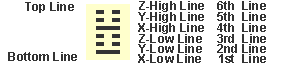
Thus,
For { Group L-2-5 } , we have this table for the [ SELF ] & the [ Reverse ] :
| SELF | Y=0 mod 4 |
Y=1 mod 4 |
Y=2 mod 4 |
Y=3 mod 4 |
|---|---|---|---|---|
 |
 |
 |
 |
|
| Reverse | |
|
|
|
| Y=0 mod 4 |
Y=3 mod 4 |
Y=2 mod 4 |
Y=1 mod 4 |
We note here that :
For { Group L-1-3-4-6 } , we have the following four (4) tables for the [ SELF ] & the [ Reverse ] :
| SELF | X=0 mod 4 Z=0 mod 4 |
X=1 mod 4 Z=3 mod 4 |
X=2 mod 4 Z=2 mod 4 |
X=3 mod 4 Z=1 mod 4 |
|---|---|---|---|---|
 |
 |
 |
 |
|
| Reverse | |
|
|
|
| X=0 mod 4 Z=0 mod 4 |
X=1 mod 4 Z=3 mod 4 |
X=2 mod 4 Z=2 mod 4 |
X=3 mod 4 Z=1 mod 4 |
We note here that each of the { 4 members } flips exactly onto itself.
| SELF | X=0 mod 4 Z=2 mod 4 |
X=1 mod 4 Z=1 mod 4 |
X=2 mod 4 Z=0 mod 4 |
X=3 mod 4 Z=3 mod 4 |
|---|---|---|---|---|
 |
 |
 |
 |
|
| Reverse | |
|
|
|
| X=2 mod 4 Z=0 mod 4 |
X=3 mod 4 Z=3 mod 4 |
X=0 mod 4 Z=2 mod 4 |
X=1 mod 4 Z=1 mod 4 |
We note here that :
| SELF | X=1 mod 4 Z=0 mod 4 |
X=0 mod 4 Z=1 mod 4 |
X=3 mod 4 Z=0 mod 4 |
X=0 mod 4 Z=3 mod 4 |
|---|---|---|---|---|
 |
 |
 |
 |
|
| Reverse | |
|
|
|
| X=0 mod 4 Z=3 mod 4 |
X=3 mod 4 Z=0 mod 4 |
X=0 mod 4 Z=1 mod 4 |
X=1 mod 4 Z=0 mod 4 |
We note here that :
| SELF | X=2 mod 4 Z=1 mod 4 |
X=1 mod 4 Z=2 mod 4 |
X=2 mod 4 Z=3 mod 4 |
X=3 mod 4 Z=2 mod 4 |
|---|---|---|---|---|
 |
 |
 |
 |
|
| Reverse | |
|
|
|
| X=3 mod 4 Z=2 mod 4 |
X=2 mod 4 Z=3 mod 4 |
X=1 mod 4 Z=2 mod 4 |
X=2 mod 4 Z=1 mod 4 |
We note here that :
Let us now summarize these findings via this set of four (4) diagrams below , i.e. :
Then, firstly, for the { X-Z planes } at [ Y = 0 mod 4 ] and at [ Y = 2 mod 4 ] :


And secondly, for the { X-Z planes } at [ Y = 1 mod 4 ] and at [ Y = 3 mod 4 ] :


We then summarize the { Rules for 'flipping' } as follows :
For the [ SELF ] situated at  and its [ REVERSE ] situated at
  , the following rules are applicable :
 } :
} :

 } :
} :

 } :
} :
 and
and 
( the { red-color and orange-color Hexagrams } )
 } :
} :
 and
and 
( the { purple-color & pink-color Hexagrams } )
 } :
} :

( the { light-green/light-blue-color & dark-green/dark-blue-color Hexagrams } )
This then demonstrate the { Non-Parity } arising from the { Reverse } process :
A very interesting branch onto { Non-parity } from a rather simple-looking procedure, i.e. the { Reverse } process.
While there may be many different principles of { Non-parity } , we shall now take this one for our purposes here :
In our { Reverse } ( 'flipping' ) context here, it is :
Let us now look at an example here in Mathematics exhibiting this principle :
We then have this example involving [ 8 ] , the { pure power-of-'2' } and [ 11 ] & [ 17 ] , the two { positive odd integers } :
And we have :
Interested readers may go to "An Approach to the Characteristics of Numbers" by the author for further details.
And { Non-parity } is also a phenomenon in Physics :
In 1956, the late Dr. Chien-Shiung Wu (  ) , of Columbia University , disproved the { Conservation of Parity } in Physics, in an experiment involving [ radioactive cobalt-60 ] .
( the author does not fully understand this one. )
And other types of { Non-Parity } are also exhibited :

{ Non-parity } is found on :
Interested readers may go to "An Approach to the Characteristics of Numbers" by the author for further details.