And the Full Count number that we shall be looking for here is [ 1 ] .

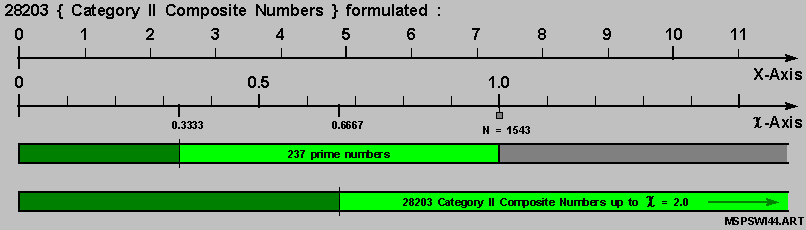
And the first thing we need to do here is to set up the { Category II Composite Numbers }
And we can now utilize the Unique-Factorization Combinatorics equation previously established in the 4th paper of the series :
to establish that :
i.e. :
where the coefficients [ 1 / 1 ] is the 2nd Row of the Pascal Triangle .
and consequently :

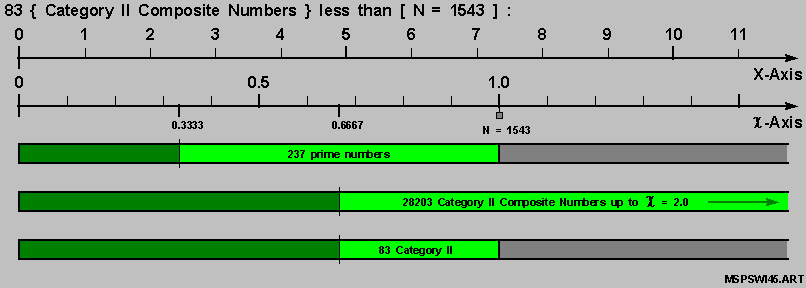
We then have this diagram below ,

| 13 | 17 | 19 | 23 | 29 | 31 | 37 | 41 | 43 | 47 | 53 | 59 | 61 | 67 | 71 | 73 | 79 | 83 | 89 | 97 | 101 | 103 | 107 | 109 | 113 | |
| 13 | 169 | 221 | 247 | 299 | 377 | 403 | 481 | 533 | 559 | 611 | 689 | 767 | 793 | 871 | 923 | 949 | 1027 | 1079 | 1157 | 1261 | 1313 | 1339 | 1391 | 1417 | 1469 |
| 17 | 221 | 289 | 323 | 391 | 493 | 527 | 629 | 697 | 731 | 799 | 901 | 1003 | 1037 | 1139 | 1207 | 1241 | 1343 | 1411 | 1513 | 1649 | 1717 | 1751 | 1819 | 1853 | 1921 |
| 19 | 247 | 323 | 361 | 437 | 551 | 589 | 703 | 779 | 817 | 893 | 1007 | 1121 | 1159 | 1273 | 1349 | 1387 | 1501 | 1577 | 1691 | 1843 | 1919 | 1957 | 2033 | 2071 | 2147 |
| 23 | 299 | 391 | 437 | 529 | 667 | 713 | 851 | 943 | 989 | 1081 | 1219 | 1357 | 1403 | 1541 | 1633 | 1679 | 1817 | 1909 | 2047 | 2231 | 2323 | 2369 | 2461 | 2507 | 2599 |
| 29 | 377 | 493 | 551 | 667 | 841 | 899 | 1073 | 1189 | 1247 | 1363 | 1537 | 1711 | 1769 | 1943 | 2059 | 2117 | 2291 | 2407 | 2581 | 2813 | 2929 | 2987 | 3103 | 3161 | 3277 |
| 31 | 403 | 527 | 589 | 713 | 899 | 961 | 1147 | 1271 | 1333 | 1457 | 1643 | 1829 | 1891 | 2077 | 2201 | 2263 | 2449 | 2573 | 2759 | 3007 | 3131 | 3193 | 3317 | 3379 | 3503 |
| 37 | 481 | 629 | 703 | 851 | 1073 | 1147 | 1369 | 1517 | 1591 | 1813 | 1961 | 2183 | 2257 | 2479 | 2627 | 2701 | 2923 | 3071 | 3293 | 3589 | 3737 | 3811 | 3959 | 4033 | 4181 |
| *** | **** | **** | **** | **** | **** | **** | **** | **** | **** | **** | **** | **** | **** | **** | **** | **** | **** | **** | **** | **** | **** | **** | **** | **** | **** |
( We shall provide further detals on the Cut-Off process later in Section XII . )


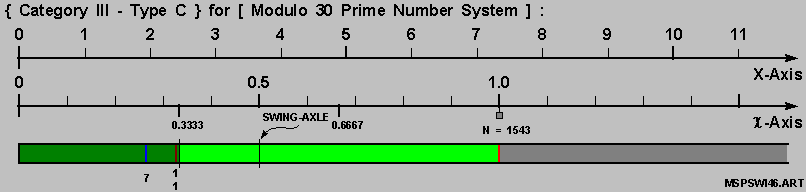
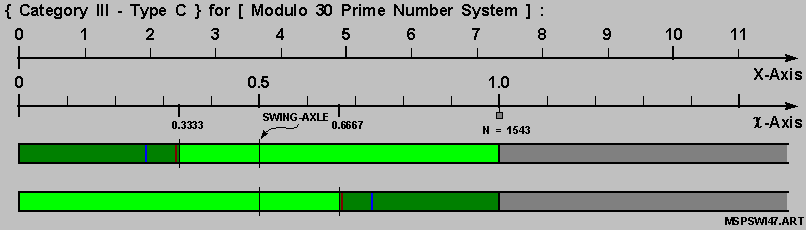
We can then proceed to do the [ SWING ] using the [ Swing Axle ] ,

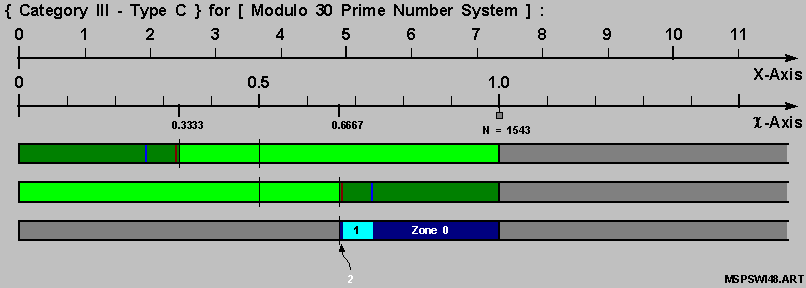
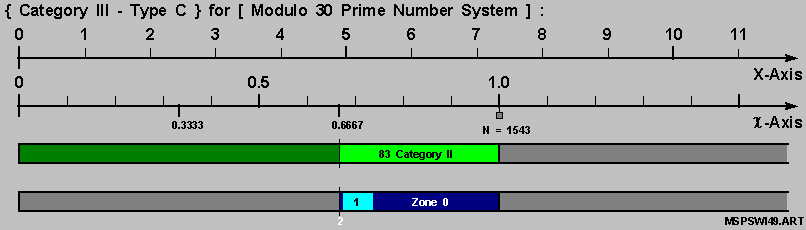
And we see here that there are now [ 2 cuts ] in the zone in-between [ chi = 0.6667 ] and [ chi = 1.0 ] ,


Let us see now how these [ 83 composite-numbers ] would fall into each of the [ 3 zones ] ,
| Range for the Zone | NumberofComposite-NumbersintheZone | Comments | ||
|---|---|---|---|---|
| Logarithmic Scalevia theCHI-Axis | Real Number Scale | |||
| Zone 0 | 0.7349 to 0.9999 | 220.42 to 1542.99 | 82 | 221 thru 1541 |
| Zone 1 | 0.6734 to 0.7349 | 140.27 to 220.42 | 1 | 169 |
| Zone 2 | 0.6667 to 0.6734 | 133.53 to 140.37 | 0 | none |
| ******* | ****************** | ****************** | ********** | ************************** |
| TOTAL | 83 | |||
We then have this table below ,
| Range for the Zone | NumberofComposite-NumbersintheZone | WeightFactor | RovingCount | ||
|---|---|---|---|---|---|
| Logarithmic Scalevia theCHI-Axis | Real Number Scale | ||||
| - - - | - - - | Q | W | Q x W | |
| Zone 0 | 0.7349 to 0.9999 | 220.42 to 1542.99 | 82 | 0 | 0 |
| Zone 1 | 0.6734 to 0.7349 | 140.27 to 220.42 | 1 | 1 | 1 |
| Zone 2 | 0.6667 to 0.6734 | 133.53 to 140.72 | 0 | 2 | 0 |
| ******* | ****************** | ****************** | ********** | ********** | ********** |
| TOTAL | 1 | ||||
( Full explanation of the { SWING priocess } and the { Zoning Process } in Section XI . )