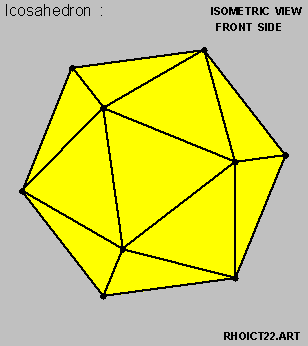
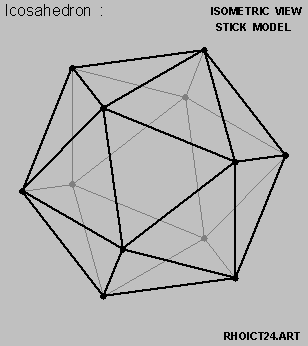
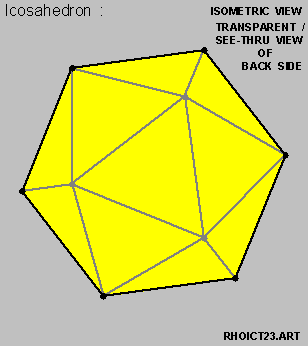
- Let recall that :
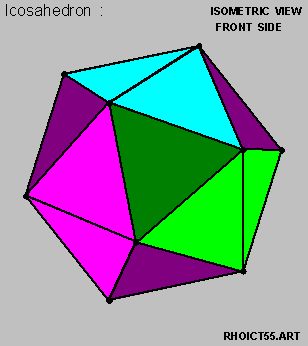
- there are always 12 Nodal-Points and 30 Edges associated with the Icosahedron ,
and
- the straight-line passing thru the mid-points of a pair of opposite Edges is always an [ Axis of Bi-Symmetry ] .
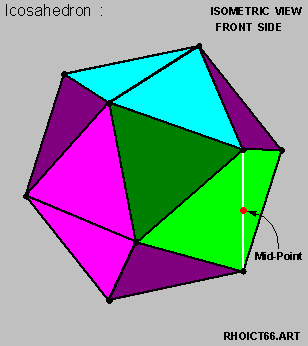
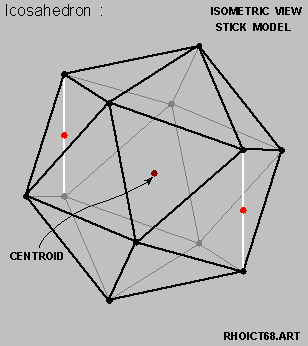
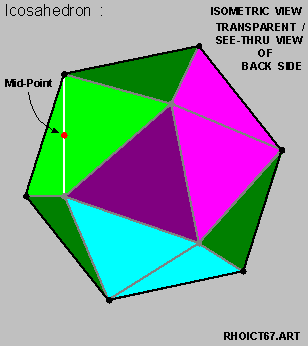
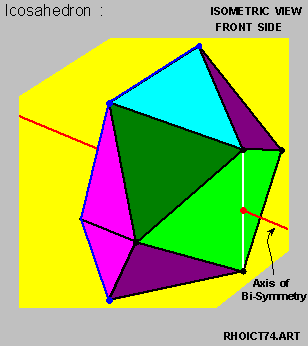
- Let us now select a [ pair of Opposite Edges ] ,
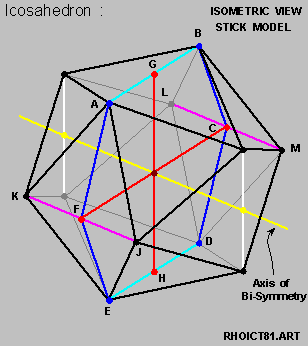
- as marked-off in [ white-color ] in the 3 diagrams below ;
and :
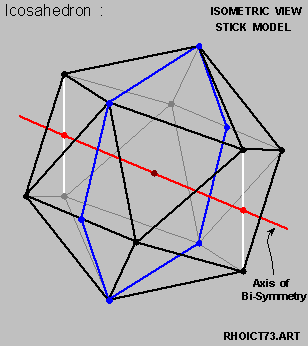
- pass a straight-line thru the mid-points of the said [ pair of opposite edges ] :
- to act as an [ Axis of Bi-Symmetry ] ,
- as per the [ red-color ] straight-line as shown in the 3 diagrams below .


- Let us now split the the Icosahedron in half , via :
- a [ bisecting plane ] perpendicular to the [ Axis of Bi-Symmetry ] passing thru Centroid of the Icoshedron ;

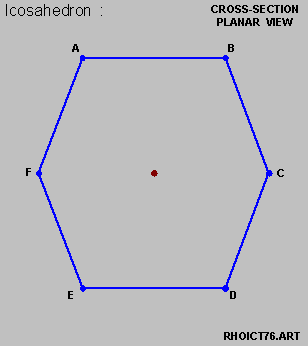
We then bring-in this set of 3 diagrams below ,
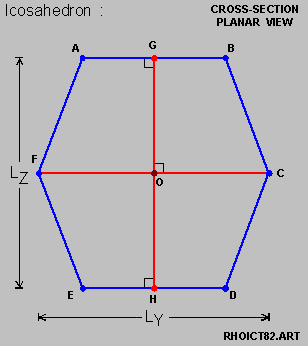
- with the diagram in-the-middle showing the Cross-Section of the Icosahedron on the [ Bisecting Plane ] .


Let us now take a closer look at the diagram on-the-right above , and we see here that :
- the 4 triangles [ Triangle A-K-J ] / [ Triangle E-J-K ] / [ Triangle D-M-L ] / [ Triangle B-L-M ]
- are split-in-half during the Bisection Process .
As such ,
- the point [ Point F ] is the mid-point of [ Line Segment J-K ] , and
- the point [ Point C ] is the mid-point of [ Line Segment L-M ] .
- Let us now denote the [ length-of-Side ] for the 20 identical Equilateral Triangles of the Icosahedron
- as the distance [ S ] ;
- same notation as in the last Section .
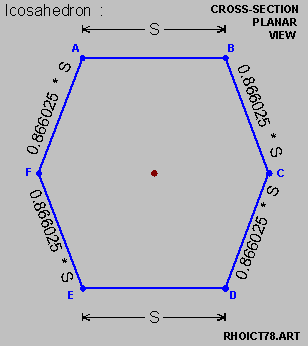
Then , refering to the diagram on-the-right above , we can now establish the following :
- Based on the equilateral triangle [ Triangle A-K-J ] :
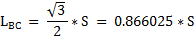
- the length of [ Line-Segment A-F ] is [ 0.866025 * S ] ;
- Based on the equilateral triangle [ Triangle E-J-K ] :
- the length of [ Line-Segment E-F ] is [ 0.866025 * S ] ;
- Based on the equilateral triangle [ Triangle D-M-L ] :
- the length of [ Line-Segment D-C ] is [ 0.866025 * S ] ;
- Based on the equilateral triangle [ Triangle B-L-M ] :
- the length of [ Line-Segment B-C ] is [ 0.866025 * S ] ;
As a result , we now have this set of 3 diagrams below ,
- with the diagram in-the-middle showing the lengths for the 6 line-segments in the [ Cross-Section Planar View ] .
- Let us now also identify , for our calculation puposes below :
- the point [ Point G ] as the mid-point of [ Line-Segment A-B ] ,
and
- the point [ Point H ] as the mid-point of [ Line-Segment E-D ] ;
- as shown in the diagram on-the-left below .

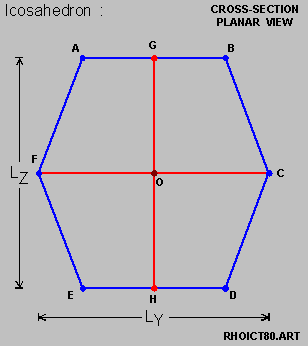
Let us now also create 2 new line-segments :
- [ Line-Segment G-H ] and [ Line-Segment F-C ] respectively ,
- as marked-off in [ red-color ] in the diagram in-the-middle above .
And we take note here that :
- [ Line-Segment G-H ] is a line joining the mid-points of a pair of [ Opposite Edges ] ,
- namely [ Edge A-B ] and [ Edge E-D ] respective ;
- [ Line-Segment F-C ] is also a line joining the mid-points of a pair of [ Opposite Edges ] ,
- namely [ Edge J-K ] and [ Edge M-L ] respective .
And based on this information , we can now come to the conclusion that :
- First :
- [ Line-Segment G-H ] and [ Line-Segment C-F ] are of-equal-length ,
i.e. :
And that-is-to-say :
- the [ mid-point to mid-point distance ] for any pair of [ Oppiste Edges ] is invariant-and-constant throughout the Icosahedron ,
- regardless of which particlular pair of [ Opposite Edges ] is selected .
- Second :
- [ Line-Segment G-H ] and [ Line-Segment C-F ] do intersect one-another at-right-angles and at their mid-points .
This is because :
- [ Line-Segment G-H ] is an [ Axis of Bi-Symmetry ] and :
- when the Icosahedron is rotated thru an angle of 180 degrees using [ Line-Segment G-H ] as the axis-of-rotation ,
- [ Point F ] and [ Point C ] are a pair of corresponding points exchanging positions .
- [ Line-Segment F-C ] is also an [ Axis of Bi-Symmetry ] and :
- when the Icosahedron is rotated thru an angle of 180 degrees using [ Line-Segment F-C ] as the axis-of-rotation ,
- [ Point G ] and [ Point H ] are a pair of corresponding points exchanging positions .
- Third :
- We can now state that :
- [ Line-Segment A-B ] intersects [ Line-Segment G-H ] at right-angles ,
and
- [ Line-Segment E-D ] also interesects [ Line-Segment G-H ] at right-angles .
And this is because :
- [ Line-Segment G-H ] is an [ Axis of Bi-Symmetry ] and :
- when the Icosahedron is rotated thru an angle of 180 degrees using [ Line-Segment G-H ] as the axis-of-rotation ,
- [ Point A ] and [ Point B ] are a pair of corresponding points exchanging positions ;
and
- [ Point E ] and [ Point D ] are also a pair of corresponding points exchanging positions .
- Let us now summarise our findings thus far with this set of 3 diagrams below :
And with this information in-hand ,
- we are now ready to do the calculations for the [ distance from Centroid to Nodal-Point ] for the Icosahedron , next .
- Let us now bring-in this set of 3 diagrams below and :
- identify [ angle G-O-B ] as the unknown angle [ Angle PHI ] that we would like to solve for ,
- as per the diagram in-the-midle below .
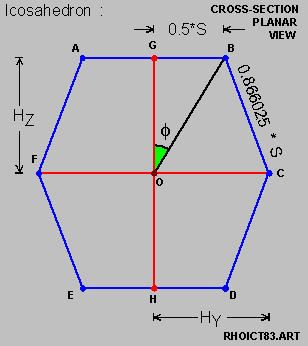
And for this diagram in-the-middle , let us just state that :

arising from :
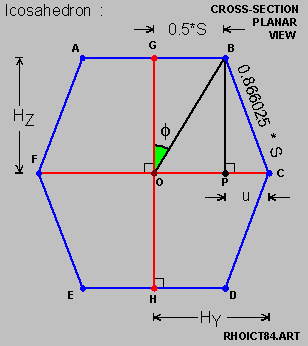
- Let us now drop a perpendicular line from [ Point B ] to the [ Line-Segment F-C ] ,
- as per the diagram on-the-right above ;
so that :
- the said Line intersects [ Line-Segment F-C ] at the point [ Point P ] as shown .
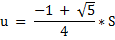
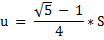
- Let us now set up the unknown variable [ u ] , being the length of [ Line-Segmemt C-P ] .
We then have immediately this relation :
And since we have already established immediately above :
-
it then follows that :
- Let us now write-out this Pythagorus Equation for the right-angle-triagle [ Triangle B-P-C ] :

where :
And we recall , at this point , that :
Substituting this and the value for [ H-sub-Z ] into the Pythagorus Equation above then yield us this :
Consequently :
- And we take note here that :
- the above equation is a Quadratic Equation based on [ S ] .
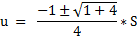
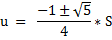
The roots to the equation here are then :
For our evaluation purposes here ,
- we would be interested only in the positive root of [ u ] .
Consequently , we take :
or :
And on numerical evaluation, we have :
- Let us now do the calculations for the [ tangent of PHI ] , and we have :
Since we have already estabished above that :
we can now write :

or :

And on numerical evaluation :
Consequently , the value of [ PHI ] is :