
| Topic #1 | Introduction & Summary for the Section |
| Topic #2 | Constructing the { C-T Tetrahedron } |
| Topic #3 | A First Glance at { Quad-Symmetry } |
| Topic #4 | Locating the { 4th Vertex } |
| Topic #5 | The 3 { Colinear Points } |
| Topic #6 | The { Equi-distant Point } |
| Topic #7 | The { Centroid } |
| Topic #8 | The { Fermat Point } |
| Topic #9 | Let's not forget |
In this Section , we shall be exploring the { C-T Tetrahedron } , or the { Congruent-Triangles Tetrahedron } , whose 4 outer-surfaces are { mutually-congruent triangles } .
The { C-T Tetrahedron } exhibits { Quad-symmetry } and has a very special property :
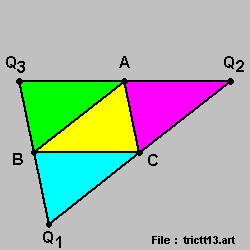
We start-off with { Triangle Q1-Q2-Q3 } on the { horizontal plane } and we identify the mid-points of the 3 sides as { Point A } , { Point B } , & { Point C } respectively .
We then have 4 { congruent triangles } as marked by the 4 different colors above .
We then attempt to fold the 3 vertices , { Point Q3 } , { Point Q1 } & { Point Q2 } respectively , upwards , creasing along the 3 { Folding-Lines } as identified in the diagram below :

Let us now take a quick-look at this procedure in 3-D :
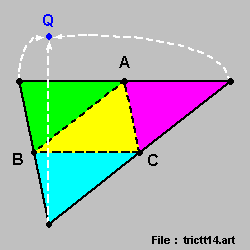
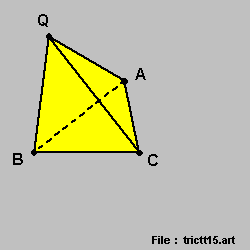
We then have our { C-T Tetrahedron A-B-C-Q } as shown above .
The { C-T Tetrahedron } then exhibits true { Quad-Symmetry } :
then , no matter which of the 4 surfaces it lands on :
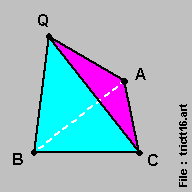
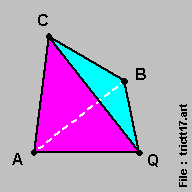
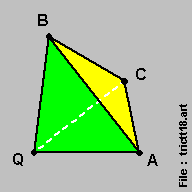
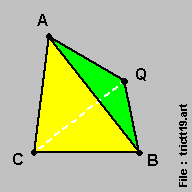
We note here that the { cube } and the { sphere } also exhibit this type of { multi-symmetry } .
We shall now attempt the locate the { 4th vertex } , i.e. { Point Q } , relative to { Triangle A-B-C } .
Let us start-off by locating the { Equi-distant Point } for { Triangle A-B-C } , as marked by { Point T } in the diagram below :

Let us now identify the { horizontal plane } and the { vertical direction } , as shown in diagram on-the-left , immediately below :


Let us now 'drop' a { vertical line } from { Point Q } to 'hit' the { horizontal plane } at { Point R } , as shown in the diagram in-the-middle , above .
And let us now work with the full { Triangle Q1-Q2-Q3 } , as shown in the diagram on-the-right , above .
We note , first-of-all , that { Point R } is , in fact :

We shall briefly explain why this is so , and we bring back this diagram with the original { Folding / Creasing Lines } , below :

Let us now take another look at the { folding operation } :
And the final position of { Point Q } is then directly ( vertically ) above { Point R } , the intersection of the 3 { perpendicular lines to the Opposite Sides } for { Triangle Q1-Q2-Q3 } .
Let us now also identify { Point S } as the intersection of the 3 { perpendicular lines to the Opposite Sides } for { Triangle A-B-C } :

Let us now also bring back { Point T } & { Point R } , identified in Topic #4 above , into the same diagram :

We simply note here that :
To understand why this is so, we bring back the 9 { lines } that identified the 3 { colinear points } :

And because , in each set of { 3 parallel lines } ,
this would then account for why { Point T } is always the mid-point of { Line R-S } .
But just why is the { line-in-the-middle } always equi-distant from the 2 { outside lines } ?
To answer this , let us now concentrate on the set of { 3 parallel lines } in { blue-color } , for the time being :

We note , first of all , that { Point E } is the mid-point of { Line A-C } .
Secondly , { Triangle A-Q2-N1 } & { Triangle C-B-N2 } are congruent triangles because :
so that :
Thus , { Point E } is necessarily the mid-point of { Line N1-N2 } , and hence :
And we can apply the same logical sequence to the other 2 sets of { 3 parallel lines } in { red-color } & in { white-color } , repsective , to complete the proof .
Let us now try to identify the point that is equi-distant from the 4 nodal-points of the { C-T Tetrahedron } .
This point is then necessarily a point on the { vertical line } passing thru { Point T } , the { equi-distant point } for { Triangle A-B-C } ,


This is because all { points } that are equi-distant from { Point A } , { Point B } & { Point C } always lie on this { vertical line } :
Let us suppose we were able to identify a point , { Point P } , on the vertical line { LIne U-V } , that is equi-distant from { Point A } , { Point B } , { Point C } & { Point Q } :
the ( height of { Point P } above the horizonal plane ) is ( the length of { Line T-P } ) .
Let us now toss the { C-T Tetrahedron } many times , so that it lands on each of the 4 surfaces at least once .
Let us now look at the position of { Point P } , for the different { landings } :


By { Quad-Symmetry } , we can conclude that the ( height of { Point P } above the horizontal plane ) for all 4 ( landings ) are always the same .
Thus , the perpendicular distance from { Point P } to any of the 4 surfaces is always the same , so that :
Let us now try to find the { Centroid } for the { C-T Tetrahedron } .
We then put a { unit-mass } at each of the 4 nodal-points and try to locate the { center-of-mass } .
We note , first of all , that the { center-of-mass } for the 3 { unit-mass's } at { Point A } , { Point B } & { Point C } is located at the { Centroid of Triangle A-B-C } , as marked by { Point Z } in this diagram below :

Let us now bring back this diagram from Topic #5 above , showing the 3 { colinear points } :

And we add { Point Z } to this diagram .
The line { Line T-Z-S } is the { Euler Line } for { Triangle A-B-C } , and this establishes that :
It then follows that :
( length of Line R-T ) is equal to ( length of Line T-S ) .
Let us now try to locate the { center-of-mass } along { Line Z-Q } , noting that :
The { center-of-mass } , or the { Centroid } , is therefore located at :


Since { Point Q } is directly ( vertically ) above { Point R } , as established in Topic #4 above , it follows that :
as per the diagram on-the-right , above .
We shall next draw a connection between the { Centroid } & the point { Point P } previously identified in Topic #6 above .
Let us , again , toss the { C-T Tetrahedron } many times so that it lands on each of the 4 surfaces at least once .
Let us now look at the position of the { Centroid } , for the different { landings } :


Again , by { Quad-Symmetry } , we can conclude that the ( height of { Centroid } above the horizontal plane ) for all 4 ( landings ) are always the same .
But the { Centroid } is directly ( vertically ) above { Point T } and is therefore on a vertical-line passing thru { Point T } :


And there is , and can be , only one single & unqiue point on that vertical-line { Line U-V } passing thru { Point T } that can exhibit this type of { Quad-Symmetry } property :
Let us briefly re-cap this statement in another manner :
and these 4 lines do intersect at a single point , { Point P } .
This point is single & unique , and any slightest deviation therefrom must result in disaster .
The point { Point P } , therefore , necessarily also serves as the { Centroid } for the { C-T Tetrahedron } .
For a { Tetrahedron } in general , we also define the { Fermat Point } as the point whose { sum of the distances to the 4 nodal-points } is { at-a-minimum } .
For our analysis here , we shall use { Pair-Pair Symmetry } , which is a phenomenon also exhibited by the { C-T Tetrahedron } :
For our analysis here , we shall use the 3rd combination :
although using the 1st or the 2nd combination would have yielded the same results .
We then start-off again with { Triangle Q1-Q2-Q3 } and the mid-points :

We then identify :
as shown in the diagram above .
We note immediately that { Line B-Y3 } & { Line C-Y2 } are of-the-same-length ,
Let us now do the { folding operations } as we have done in Topic #2 above ,


as per the diagram on-the-right , above .
We note , first-of-all , that { Line B-C } and { Line Q-A } are of-the-same-length ,
And secondly , we note that the lines { Line B-Y } and { Line C-Y } remain equal-in-length ,
Thus , { Triangle B-Y-C } is an isosceles triangle .
We then join the end-points to form { Line X-Y } :

Since { Point X } is the mid-point of { Line B-C } , it follows , from the isosceles triangle , that :
Let us now toss the { C-T Tetrahedron } many times until it lands on { Triangle C-Q-A } , as per the diagram on-the-right , below :


Comparing this with the original orientation , as per the diagram on-the-left , above , then leads us to conclude that :
because of { Quad-Symmetry } .
Let us now proceed to find the { Fermat Point } using :
But first , let us briefly review the { ellipse } , for our later use :


An { ellipse } is then the set of all points whose ( sum of distances to the 2 { Focus Points } ) is constant .
And this constant { K } may be expressed in terms of :
as per the diagram on-the-left , above .
i.e. :

And on a 3-D basis , the set of all points whose ( sum of distances to the 2 { Focus Points } ) is constant , is then :
Let us now proceed to find the { Fermat Point } using 2 { Solid-Of-Revolution Ellipsoids } based on { Line B-C } and { Line Q-A } :


Based on the fact that { Line B-C } & { Line Q-A } are equal-in-length and based on { Pair-Pair Symmery } , we can conclude that :
Secondly , the 2 { Solid-Of-Revolution Ellipsoids } must be { just touching one-another } , at the { Fermat Point } ,
To zero-in of the { Fermat Point } , let us now start with 2 rather-small but equal-sized { Soild-Of-Revolution Ellipsoids } based on { Line B-C } & { Line Q-A } , respectively .
Let us now look at the intersections of the 2 growing-but-equal-sized { Solid-Of-Revolution Ellipsoids } with { Line X-Y } :
so that the { intersection point } moves from { Point X } towards the { mid-point of Line X-Y } as the said-ellipsoid increases in size .
so that the { intersection point } moves from { Point Y } towards the { mid-point of Line Y-X } as the said-ellipsoid increases in size .
And the { growing process } stops when both { intersection points } hit the same point , the { mid-point of Line X-Y } .
Let us temporarily label this point , the mid-point of { Line X-Y } , as { Point M } and we notice that :
so that { Line B-M } , { Line C-M } , { Line Q-M } & { Line A-M } are all equal-in-length .
Thus , { Point P } , the { Equi-distant Point } as identified in Topic #5 above , also serves as the { Fermat Point } .
Let us not forget that the { Total Surface Area } for the { C-T Tetrahedron } is 4 times the area of the { base congruent Triangle } !