 } , and
- { Point R } , { Point S } & { Point T } are on the edge of the circle ,
as per the diagram on-the-left , below :
In this Section , we shall develop a { Shape Classification System } for the Triangle ,
And this classification system does incorporate the special case of the { 3-colinear-points Triangle } :
This then lays the foundation works for further explorations & analysis in :
Let us start-off the { Shape Classification System } by introducing :
} , and
as per the diagram on-the-left , below :

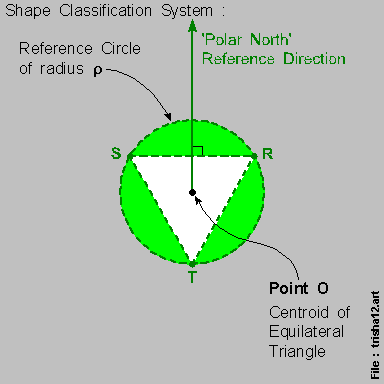
We then identify { Point O } as the center of the circle , which is also centroid of the equilateral triangle , as per the diagram on-the-right , above .
We also identify , for reference purposes , the { 'Polar North' Reference Direction } arising from ( Point O } :
as per the diagram on-the-right , above .
Let us now pick a point , { Point P } , which always resides within the boundaries of the circle :
 } , and
as per the diagram on-the-left , below :

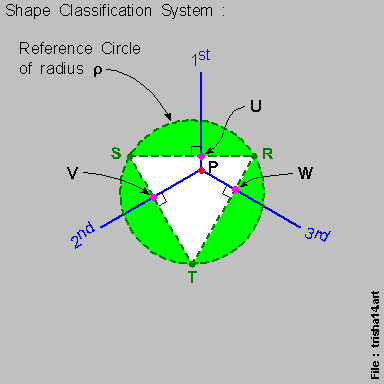
Let us now 'drop' / construct 3 lines arising from { Point P } so that :
as per the diagram on-the-right , above .
We then identify 3 new points as follows :
as shown in the diagram on-the-left , below :
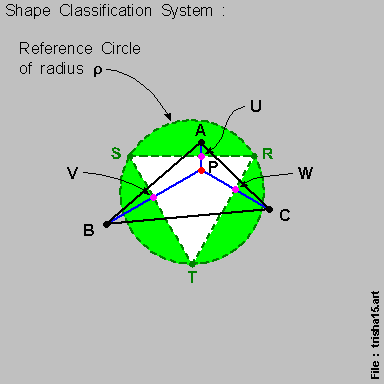

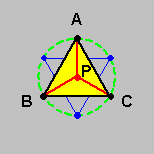
We then have { Triangle A-B-C } as the triangle associated with this particular { Point P } , as shown on the diagram on-the-right , above .
Thus , for each & every different { Point P } resident within the boundaries of the { circle } :
We note , first-of-all , that when { Point P } is at the { center of the circle } , the resultant { Triangle A-B-C } is an equilateral triangle , as per this diagram below :
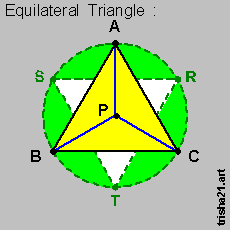
We note here that :
because { Line A-P } , { Line B-P } & { Line C-P } are each perpendicular to a different side of an equilateral triangle and therefore intesects one-another at { 120 degrees } ,
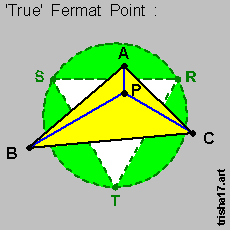

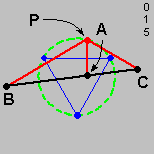
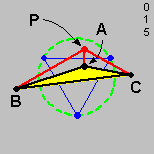
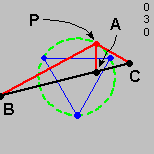
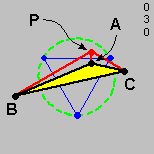
It is 'pseudo' in the sense that , for a triangle { Triangle A-B-C } with an { obtuse angle greater than 120 degrees } at { Point A } :
we do arrive at { Point P } as being the intersection of { Line A-D } , { Line B-E } & { Line C-F } , as per the diagram on-the-right , below :
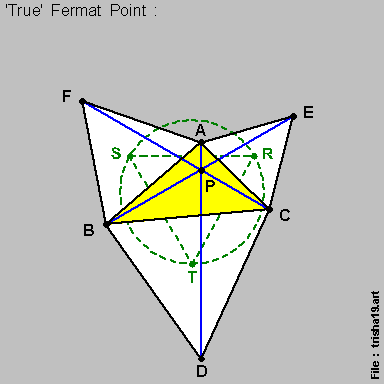
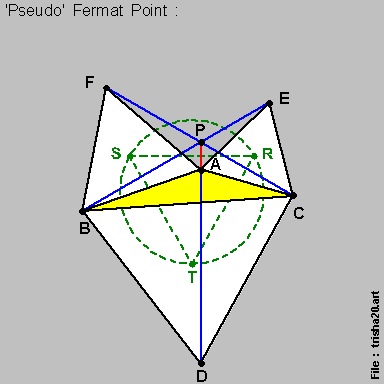
And we now bring-in the diagram on-the-left , above , for the 'true' { Fermat Point } , for comparison purposes .
We simply note here that :
In certain sense , the { length of Line P-A } may be consindered 'negative' when the [ angle at { Point A } ] is greater than [ 120 degrees ] .
But this does not really have any significant impact on our { Shape Classification System } here ,
to be further discussed in [ Topic #4 ] in the next section , Section VI .
Let us now look at the differently shaped triangles associated with differently located { Point P's } .
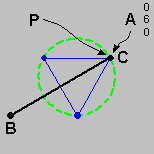
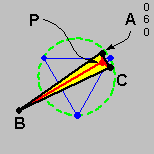
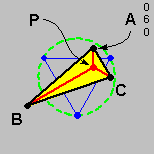
Let us first move-in from the { edge of the circle } towards the { center of the circle } :
as identified in this diagram below :
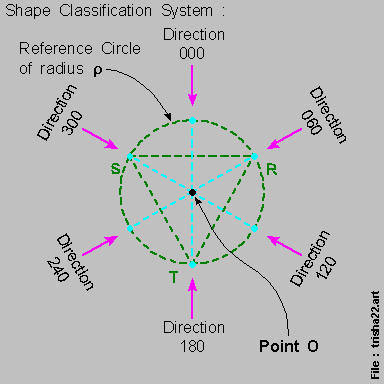
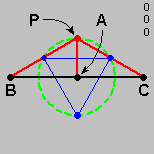
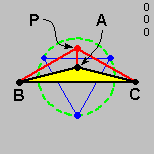
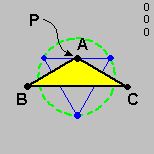
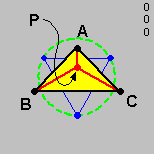
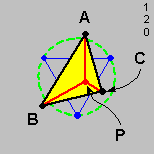
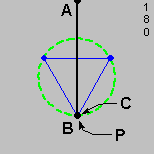
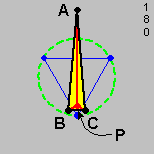
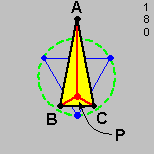
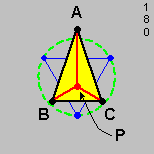
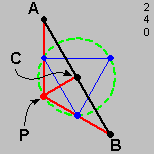
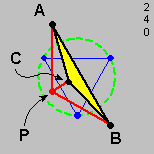
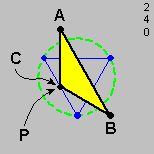
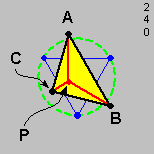
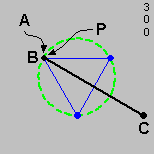
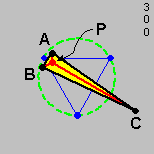
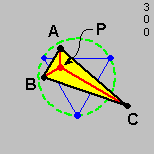
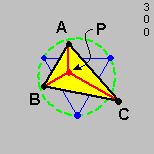
We then have these 6 tables of { triangular shapes } below :
| Edge of Circle | ---> | Half-way | ---> | Center of Circle |
|---|---|---|---|---|
 |
 |
 |
 |
 |
| Edge of Circle | ---> | Half-way | ---> | Center of Circle |
|---|---|---|---|---|
 |
 |
 |
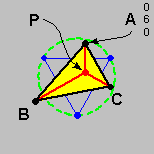 |
|
| Edge of Circle | ---> | Half-way | ---> | Center of Circle |
|---|---|---|---|---|
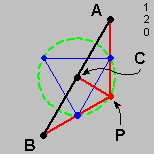 |
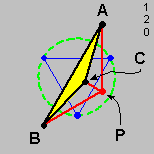 |
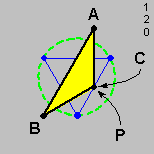 |
 |
|
| Edge of Circle | ---> | Half-way | ---> | Center of Circle |
|---|---|---|---|---|
 |
 |
 |
 |
|
| Edge of Circle | ---> | Half-way | ---> | Center of Circle |
|---|---|---|---|---|
 |
 |
 |
 |
|
| Edge of Circle | ---> | Half-way | ---> | Center of Circle |
|---|---|---|---|---|
 |
 |
 |
 |
|
We now make 2 observations :
Let us now take a second look and move-in from the { edge of the circle } towards the { center of the circle } :
as identified in this diagram below :
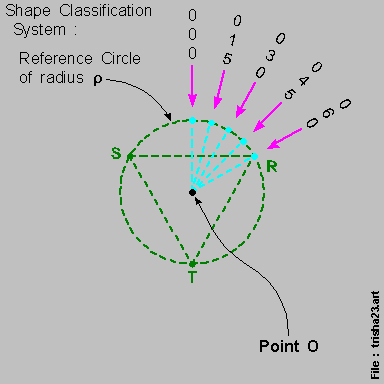
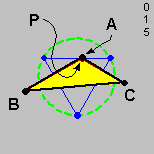
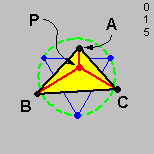
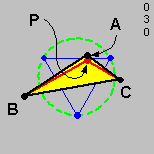
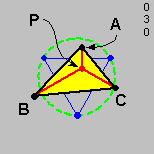
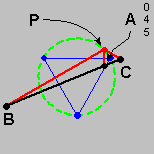
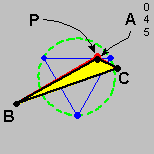
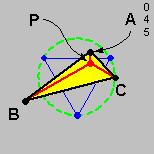
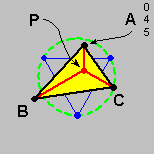
We then put these 5 Directions on a single table , for easier understanding & comparison purposes :
| Edge of Circle | ---> | Half-way | ---> | Center of Circle |
|---|---|---|---|---|
|
|
|
|
|
 |
 |
 |
 |
|
 |
 |
 |
 |
|
 |
 |
 |
 |
|
|
|
|
|
|
We observe , again , that :
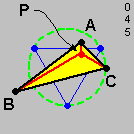
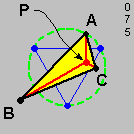
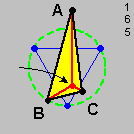
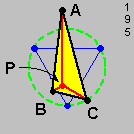
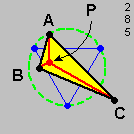
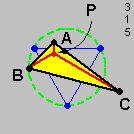
The reader should also take note of the { Triple-Pairs / Hexa-symmetric } nature of this system , as per this demonstration below :
| Half-Way at Direction 045 |
Half-Way at Direction 075 |
Half-Way at Direction 165 |
Half-Way at Direction 195 |
Half-Way at Direction 285 |
Half-Way at Direction 315 |
|---|---|---|---|---|---|
 |
 |
 |
 |
 |
 |
And the { Triple-Pairs } consolidate into { Triple-Singles } for the { isoceles triangles } , as per this demonstration below :
| Half-Way at Direction 060 |
Half-Way at Direction 180 |
Half-Way at Direction 300 |
|---|---|---|
|
|
|
We hope we have developed a powerful { Shape Classification System } which may have many applications .
In our { Shape Classification System } here , { radius } of the { Reference Circle } is controlling on the size of the resultant { triangle } , i.e. :
} & the [ ratio of { distance O-P } : { radius } ] constant ,
the size of { Triangle A-B-C } will increase as we increase { radius } .
Our proposal on { size } here is to set up a { 3-Dimensional Space } so that :
} always lie on the horizontal plane ,
} of the { Reference Circle } increases linearly as we move-up in the vertical direction ,
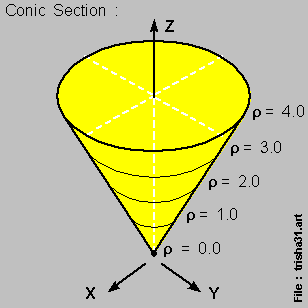
Any point { Point P } resident within the boundaries of the { Conic Section } would then represent a { differently sized & differently shaped triangle } , { Triangle A-B-C } .
This can be rather convenient when we investigate [ mapping { Triangles } onto { Triangles } ] in Section VIII .
But 2 preliminary thoughts here for further considerations , at this juncture :
Could be interesting !